

Showing posts with label Isis. Show all posts
Showing posts with label Isis. Show all posts
Pictures: Nut, Geb and Shu
 The sky goddess Nut stretches over her brother-husband, the fertile earth god Geb. The two have quarrelled, and are being held apart by their father, the air god Shu. Nut will soon give birth to Osiris, Isis, Seth and Nephthys.
Tags:
Ancient Egypt Pictures,
Egyptian Gods,
Geb,
Isis,
Nut,
Osiris,
Reliefs of Ancient Egypt,
Seth,
Shu

Picture: Isis and Horus

Ancient Egypt Pictures
As the dynastic age progressed, Isis' role as the mother and protector of the infant king Horus grew in popularity. Art historians have speculated that images of Isis nursing Horus may have inspired the early Christian artists who depicted Mary with the infant Jesus in a similar fashion.

Queen Hatshepsut
(Don't forget to sign up for the FREE Egyptology course from Ancient Egypt History)

Thutmose II married his half-sister, the King's Daughter, King's Sister and King's Great Wife Queen Hatshepsut who, having inherited the office of God's Wife of Amun from Meritamun, used this as her preferred title. Egypt's new queen started to build a suitable consort's tomb in the remote Wadi Sikkat Taka el-Zeida, on the Theban west bank. Here her quartzite sarcophagus was inscribed with a prayer to the mother goddess Nut:
By year 7 Queen Hatshepsut had been crowned king of Egypt, acquiring in the process a full king's titulary of five royal names - Horus, Powerful-of-Kasi Two Ladies, Flourishing-of-Years; Female Horus of Fine Gold, Divine-of-Diadems; King of Upper and Lower Egypt, Maatkare (Truth is the Soul of Re); Daughter of Ra, Khenmet-Amun Hatshepsut (the One who is joined with Amun, the Foremost of Women). Thutmose III was
Divine Birth of Queen Hatshepsut:
A single stela, raised at Armant, tells us that Queen Hatshepsut died on the tenth day of the sixth month of the 22nd year of her reign. Finally Thutmose was free to embark on what would be 33 years of highly successful solo rule. First, however, he had to bury his predecessor to consolidate his claim to the throne. Queen Hatshepsut's tomb was looted in antiquity, but included amongst the debris left by the robbers were two vases - family heirlooms? - made for Queen Ahmose-Nefertari. We have Queen Hatshepsut's sarcophagus and her matching canopic chest, and a few fragments of her furniture, but her body has vanished. All that remains is a box recovered from the Deir el-Bahari mummy cache, decorated with Queen Hatshepsut's cartouch and holding mummified tissue identified rather loosely as either a liver or a spleen. We do, however, have several nameless New Kingdom female mummies who might, or might not, be Queen Hatshepsut. Chief amongst these are the 'Elder Lady', a female mummy in her 40s recovered from a sealed side-chamber in the tomb of Amenhotep II (KV 35) and an obese female mummy with red-gold hair discovered in the tomb of the royal nurse Sitre (KV 60). Sitre is known to have been Queen Hatshepsut's wet-nurse, and a badly damaged limestone statue shows her sitting with the young Hatshepsut (a miniature adult rather than a child) on her lap.


Thutmose II married his half-sister, the King's Daughter, King's Sister and King's Great Wife Queen Hatshepsut who, having inherited the office of God's Wife of Amun from Meritamun, used this as her preferred title. Egypt's new queen started to build a suitable consort's tomb in the remote Wadi Sikkat Taka el-Zeida, on the Theban west bank. Here her quartzite sarcophagus was inscribed with a prayer to the mother goddess Nut:
The King's Daughter, God's Wife, King's Great Wife, Lady of the Two Lands, Queen Hatshepsut, says, 'O my mother Nut, stretch over me so that you may place me amongst the undying stars that are in you, and that I may not die.'
The Wadi Sikkat Taka el-Zeida tomb would be abandoned before the burial shaft could be completed.
Hatshepsut the Consort
Queen Hatshepsut bore her brother one daughter, Neferure, but no son. And so, when Thutmose II died unexpectedly after maybe 13 years on the throne, the crown passed to Thutmose III, a son born in the royal harem to the lady Isis. As the new king was still an infant, and as the new King's Mother was not considered sufficiently royal to act as regent, Queen Hatshepsut was called upon to rule on behalf of her stepson. Thutmose III, proud of his mother and perhaps eager to inflate his lineage, would later promote Isis posthumously to the roles of King's Great Wife and God's Wife. We may see Isis on a pillar in Thutmose's tomb (KV 34) where she stands behind her son in a boat. Here she wears a simple sheath dress and tripartite wig but no crown. In contrast, a statue of Isis recovered from Karnak shows her wearing a modius and double uraeus.
His son has risen in his place as King of the Two Lands. He [Thutmose III] ruled on the throne ofhe who had begotten him. His sister, the God's Wife Queen Hatshepsut, governed the land and the Two Lands were advised by her. Work was done for her and Egypt bowed its head.
For several years Queen Hatshepsut acted as a typical regent, allowing the young Thutmose to take precedence in all activities. But already there were signs that Queen Hatshepsut was not afraid to flout tradition. Her new title, Mistress of the Two Lands, was a clear reference to the king's time-hon-oured title Lord of the Two Lands. More unusually, she commissioned a pair of obelisks to stand in front of the gateway to the Karnak temple of Amun. Obelisks - tall, thin, tapering shafts of hard stone whose pyramid-shaped tops, coated with gold foil, sparkled in the strong Egyptian sunlight - were understood to represent the first rays of light that shone as the world was created. Very difficult to cut and transport, and so difficult to erect that modern scientists have not yet managed to replicate the procedure, they had thitherto been the very expensive gifts of kings to their gods. By the time her obelisks were cut, Queen Hatshepsut too had become a king, and her new titles were engraved with pride on her monuments.
Hatshepsut the King!
By year 7 Queen Hatshepsut had been crowned king of Egypt, acquiring in the process a full king's titulary of five royal names - Horus, Powerful-of-Kasi Two Ladies, Flourishing-of-Years; Female Horus of Fine Gold, Divine-of-Diadems; King of Upper and Lower Egypt, Maatkare (Truth is the Soul of Re); Daughter of Ra, Khenmet-Amun Hatshepsut (the One who is joined with Amun, the Foremost of Women). Thutmose III was
never forgotten. He was scrupulously acknowledged as a co-ruler and the now-joint regnal years continued to be counted from the date of his accession, but Queen Hatshepsut was undeniably the dominant king of Egypt. Only towards the end of Queen Hatshepsut's life would Thutmose acquire anything like equal status with his co-ruler.
We can chart Queen Hatshepsut's journey from conventional consort to king in a series of contrasting images. A stela now housed in Berlin Museum shows us the royal family shortly before Thutmose's death. The young king stands facing the sun god Re. Directly behind him stands his step-mother/mother-in-law Ahmose wearing the vulture headdress and uraeus topped with tall feathers. Queen Hatshepsut stands dutifully behind her mother, her plain sheath dress and simple platform crown emphasizing the fact that here she is very much the junior queen. The modius or plat-form crown, decorated with flower stalks, was worn by a variety of not particularly prominent New Kingdom royal women. Two years after the death of Thutmose II, images carved at the Semna Temple, Nubia, show an adult-looking Thutmose III, sole King of Upper and Lower Egypt and Lord of the Two Lands, receiving the white crown from the ancient Nubian god Dedwen. Finally Hatshepsufs Red Chapel at Karnak shows Queen Hatshepsut and Thutmose III standing together. The two kings are identical in appearance, both wearing the kilt and the blue crown, botb carrying a staff and an ankh, and both with breastless male bodies. Their cartouches confirm that it is Thutmose who stands behind Queen Hatshepsut in the more junior position.
Queen Hatshepsut offers us no explanation for her unprecedented assumption of power. It seems that there was no opposition to her elevation although, of course, it is very unlikely that any such opposition would have been recorded. We can only guess that it was precipitated by a political or theological crisis requiring a fully adult king. Carved into the walls of her religious monuments Queen Hatshepsut does, however, offer some justification. Queen Hatshepsut is entitled to claim the throne because she is not only the beloved daughter and intended heir of the revered Thutmose I (the less impressive Thutmose II being conveniently forgotten); she is also the daughter of the great god Amun. And he, via an oracle revealed to Queen Hatshepsut herself, has proclaimed his daughter King of Egypt.
Divine Birth of Queen Hatshepsut:
Queen Hatshepsut's semi-divine nature is emphasized on the walls of her mortuary temple, where a cartoon-like sequence of images and a brief accompanying text tell the story of her divine birth. Amon, we learn, has fallen in love with a beautiful queen of Egypt, and has determined to father her child. In one of the few scenes showing a queen communicating directly with a god, we can view Queen Ahmose sitting unchaperoned in her boudoir. Here she is visited by Amon who, for propriety's sake, has disguised himself as her husband. Amon tells Ahmose that she has been chosen to bear his daughter, the future king of Egypt. Then he passes her the ankh that symbolizes life, and his potent perfume fills the palace. Meanwhile, in heaven, the ram-headed creator god Khnum crafts both the baby and the baby's soul on his potter's wheel. Nine months later it is time for the birth. The pregnant Ahmose, her baby bump barely visible, is led to the birthing bower by Khnum and the frog-headed midwife Heket. Here, in a scene discreetly left to the imagination, Queen Hatshepsut is born.
Amon is overwhelmed with love for his new daughter. He takes her from Hathor the divine wet nurse, kisses her and speaks:
Come to me in peace, daughter of my loins, beloved Maatkare, thou art the king who takes possession of the diadem on the Throne of Horus of the Living, eternally.
The temple walls show Egypt's new, naked king with an unmistakably male body; her identical and equally naked soul, too, is obviously male. But the new king's names are female, and neither Ahmose nor Amon is in any doubt over the gender of their child. The presentation of Queen Hatshepsut as a male is purely a convention, her response to the artistic dilemma that, three centuries before, saw Sobeknefru don an unhappy mixture of men's and women's clothing. As a queen Hatshepsut had been happy to be portrayed as a conventional woman: slender, pale and passive. But as a king she needed to find an image that would reinforce her new position while distancing her from the consort's role. Towards the beginning of her reign she was depicted either as a conventional woman or as a woman wearing [male] king's clothing. Two seated limestone statues recovered from Deir el-Bahari show her dressed in this hybrid manner. Queen Hatshepsut wears the traditional headcloth and kilt. She has a rounded, feminine, unbearded face and a feminine body with breasts and an indented waist. Soon, however, she evolves into an entirely masculine king, with a man's body, male clothing, male ccessories and male ritual actions. It seems that it is the appearance of the king that matters rather than her actual gender; the masculine form of Queen Hatshepsut is happy to alternate between masculine and feminine forms of her titulary.
Princess Neferure, the Queen of Hatshepsut:
From the time of her coronation onwards, Queen Hatshepsut was careful to behave as an entirely conventional King of Egypt; in consequence, while her story tells us a great deal about the perceived role of the king, it tells us less about the role of the queen than we might have hoped. It does, however, confirm one very important detail: that the queen was an important element of the kingship. Like any other king, Queen Hatshepsut needed a queen to fulfil the feminine aspect of her monarchy, and for this she turned to her daughter Neferure. Most of Egypt's royal children remain hidden in their nurseries throughout their childhoods and, during her father's reign, Neferure had been no exception. But following her mother's coronation, Neferure started to play an unusually prominent role - the queen's role - in public life. Neferure used the titles Lady of Upper and Lower Egypt and Mistress of the Lands and she assumed the office of God's Wife of Amun, a role that Queen Hatshepsut had been forced to abandon as it was incompatible with her kingly status. Neferure, like all other God's Wives before her, adopted this as her preferred title. Scenes carved on the walls of the Red Chapel at Karnak show Neferure as a fully adult woman performing the appropriate rituals.
Neferure's education was clearly a matter of some importance. The young princess was taught first by the courtier Ahmose-Pennekhbet, next by Senenmut, Queen Hatshepsut's most influential advisor, and finally by the administrator Senimen. A series of hard stone statues - highly expensive, produced by the royal workshops - show Neferure and Senenmut together. Neferure has the shaven head and sidelock of youth worn by all Egyptian children. Senenmut, dressed in a heavy striated wig, assumes a typical woman's role by either holding the princess tight, or seating her on his knee and wrapping her body in his cloak. Neferure disappears
towards the end of her mother's reign; she appears on a stela at Serabit el-Khadim in Year II, but is unmentioned in Senenmut's tomb dated to Year 16. The obvious assumption is that she has died and been buried in her tomb which lay near that built for her mother in the remote Wadi Sikkat Taka el-Zeida.
Senenmut, Queen Hatshepsut's Advisor
The new king inherited her late brother's courtiers but gradually, as her reign developed, she started to pick new advisors, many of whom, like Senenmut, were men of relatively humble birth. As Queen Hatshepsut well realized, these self-made men had a vested interest in keeping her on the throne: if she fell, they fell with her. Senenmut, Steward of Amun and tutor to Princess Neferure, enjoyed a meteoric rise through the ranks, and this has sparked a great deal of speculation over the precise nature of his relationship with Queen Hatshepsut. They certainly never married - marriage was not an option for a female king, as it would lead to too great a conflict of roles - but could they have been lovers? A crude piece of graffiti scrawled in a Deir el-Bahari tomb, which apparently shows a man having 'doggy-style' intercourse with a woman wearing a royal headdress, cannot be accepted as conclusive proof of anything other than the fact that the ancient Egyptians enjoyed smutty gossip as much as any other people. The fact that Senenmut carved his image into Queen Hatshepsut's mortuary temple - an unprecedented and daring move for a non-royal- combines with the fact that his second tomb encroached upon the Deir el-Bahari precincts to offer a more convincing argument in favour of a close bond between the two. It is difficult to imagine that Senenmut could have ordered these infringements of protocol without Queen Hatshepsut's knowledge and tacit approval.
Queen Hatshepsut's Policy
The new king set out to maintain maat by launching an obvious assault on chaos. Foreigners were to be subdued, the monuments of the ancestors were to be restored, and the whole of Egypt was to be enhanced by a series of ambitious temple-building projects. The subduing of the foreigners was quickly achieved in a token series of military campaigns against the vassals to the south and east. The Deir el-Bahari temple again shows the Nubian god Dedwen, this time leading a series of captive Nubian towns leach depicted as a walled town or fortified cartouch bearing an obviously Nubian head) towards the victorious Queen Hatshepsut.
Next, Queen Hatshepsut turned her attention to trade. There were missions to the Lebanon for wood, increased exploi tation of the copper and turquoise mines in Sinai and, most important of all, during Year 9, a successful trading mission to Punt. The real but almost legendary land of Punt was a source of many exotic treasures: precious resins, curious wild animals, and the ever-desirable ebony, ivory and gold. It was, however, a long way from the safety of Thebes. The exact location of Punt is now lost, but flora and fauna included in the reliefs decorating Queen Hatshepsut's mortuary temple suggest that it was an east African trading centresituated somewhere along the Eritrean/Ethiopian coast. The journey to this distant Utopia involved a long, hot march across 100 miles (160 km) of desert, possibly carrying a dismantled boat, to the Red Sea port of Quseir. This was followed by a sea journey along the coast, an adventure that the Egyptians, always very happy on the calm waters of the Nile, dreaded.
Queen Hatshepsut's envoy Neshy set sail with a small but well-armed army, his precise route undisclosed. After some sharp bargaining with the chief of Punt - the temple walls show a handful of trinkets being exchanged for
a wonderful array of goods, but doubtless they exaggerate - he returned home in triumph. Queen Hatshepsut, watching as her ships disgorged their valuable cargos at Thebes, must have been overjoyed. The safe return of her troops proved beyond a shadow of a doubt that her reign was indeed blessed by her divine father. With great perspicacity she promptly donated the best of the goods to Amun, and ordered that the epic voyage be immortalized on the Deir el-Bahari temple walls.
Queen Hatshepsut's Projects Building
Back at home the building projects were proceeding well. It seems likely that Queen Hatshepsut instigated a temple-building project in all of Egypt's major cities, but most of these temples have been lost along with their cities, leaving the Theban monuments to stand as testimony to the prosperity of her reign. We know that there were building works in Nubia, and at Kom ambo, Hierakonpolis, Elkab, Armant and the island of Elephantine, which received two temples dedicated to local gods. In Middle Egypt, not far from Beni Hassan and the Hatnub quarries, Egypt's first two rock-cut temples were dedicated to the obscure lion-headed goddess Pakhet, 'She who Scratches', a local variant of the goddess Sekhmet, who was herself a variant of Hathor. On one of these temples, known today bits Greek name Speos Artemidos (Grotto of Artemis), Queen Hatshepsut carved a bold statement setting out her policy of rebuilding and restoration:
I have never slumbered as one forgetful, but have made strong what was decayed. I have raised up what was dismembered, even from the first time when the Asiatics were in Avaris of the North Land, with roving hordes in the midst of them overthrowing what had been made; they ruled without Ra.... I have banished the abominations of the gods, and the earth has removed their footprints.
In suggesting that she has personally expelled the Hyksos from Egypt, Queen Hatshepsut is being more than economical with the truth; such an outrageous lie can, however, be justified if we take the view, as Queen Hatshepsut
herself undoubtedly did, that each of Egypt's kings was a continuation of the kings who had gone before and so fully entitled to claim his deeds for his (or her) own, Her assertion that she is renewing and restoring damaged monuments does appear to be true within the modern meaning of the term, We know, for example, that she repaired the temple of Hathor at the town of Cusae, a town which, situated on the border between the Theban and Hyksos kingdoms, suffered badly during the wars that ended the 17th Dynasty, The Karnak temple benefited greatly from the new king's generosity, There was another pair of obelisks - this time entirely covered in gold foil - raised to commemorate Queen Hatshepsut's 15-year jubilee, a new bark shrine (the Red Chapel) where Amun's processional boat could rest, a new southern pylon (gateway), a new royal palace and a series of improvements to the processional routes which linked the various temples within the complex, But the most magnificent building she commissioned was a mortuary temple for herself, situated close by the Middle Kingdom tomb of Mentuhotep II in the Deir el-Bahari bay.
Deir el-Bahari, Queen Hatshepsut's Mortuary Temple.
Deir el-Bahari was a multi-functional temple with a series of shrines and chapels devoted to a variety of gods. The main sanctuary was dedicated to Queen Hatshepsut's divine father, Amun. But there was also a suite of chapels
devoted to the royal ancestors; this included a small mortuary or memorial chapel for her earthly father, Thutmose I, and a much larger mortuary chapel for Queen Hatshepsut herself. Here, in front of Queen Hatshepsut's cult statue, the priests could make the daily offerings of food, drink, music and incense that would allow the dead king's soul to live forever. An open-air court dedicated to the worship of the sun god Re-Herakhty balanced the dark and gloomy mortuary chapels, chapels that linked the dead with the cult of Osiris. One level down were the chapels dedicated to the god of embalming, Anubis, and to Hathor, who was not only the goddess of the Deir el-Bahari bay, but also 'Mistress of Punt'. Like many of Egypt's queens, Hatshepsut (now an ex-queen) felt a particular attraction to Hathor's predominantly female cult, and Hathor features prominently in her temple. She is present at Hatshepsut's birth and later, taking the form of a cow, suckles a newborn infant. If Amon can be considered the divine father of the king, it seems that Hathor is now his (or her) mother.
The mortuary temple was one half of Queen Hatshepsut's mortuary provision. Her tomb, the other half, was to be in the Valley of the Kings, the now traditional cemetery for Egypt's kings. The old consort's tomb in the Wadi Sikkat Taka el-Zeida was abandoned, but Queen Hatshepsut (perhaps concerned about her lack of time) did not try to build a replacement. Instead she started to enlarge the tomb (KV 20) which already held her father, until it became the longest and deepest tomb in the Valley. Eventually, or so she hoped, father and daughter would lie side-by-side forever in two matching yellow quartzite sarcophagi (Thutmose l's sarcophagus, a shade less magnificent than Queen Hatshepsut's own, was actually a second-hand sarcophagus originally prepared for his daughter). The two did indeed lie together for a time, but Thutmose III eventually had his grand-father reinterred in a nest of new coffins placed in a new sarcophagus in a brand new tomb (KV 38).
The End of the Era of Queen Hatshepsut
A single stela, raised at Armant, tells us that Queen Hatshepsut died on the tenth day of the sixth month of the 22nd year of her reign. Finally Thutmose was free to embark on what would be 33 years of highly successful solo rule. First, however, he had to bury his predecessor to consolidate his claim to the throne. Queen Hatshepsut's tomb was looted in antiquity, but included amongst the debris left by the robbers were two vases - family heirlooms? - made for Queen Ahmose-Nefertari. We have Queen Hatshepsut's sarcophagus and her matching canopic chest, and a few fragments of her furniture, but her body has vanished. All that remains is a box recovered from the Deir el-Bahari mummy cache, decorated with Queen Hatshepsut's cartouch and holding mummified tissue identified rather loosely as either a liver or a spleen. We do, however, have several nameless New Kingdom female mummies who might, or might not, be Queen Hatshepsut. Chief amongst these are the 'Elder Lady', a female mummy in her 40s recovered from a sealed side-chamber in the tomb of Amenhotep II (KV 35) and an obese female mummy with red-gold hair discovered in the tomb of the royal nurse Sitre (KV 60). Sitre is known to have been Queen Hatshepsut's wet-nurse, and a badly damaged limestone statue shows her sitting with the young Hatshepsut (a miniature adult rather than a child) on her lap.
Erasing Queen Hatshepsut
Towards the end of Thutmose's reign an attempt was made to delete Queen Hatshepsut from the historical record. This elimination was carried out in the most literal way possible. Her cartouches and images were chiselled off the stone walls -leaving very obvious Queen-Hatshepsut-shaped gaps in the artwork - and she was excluded from the official history that now ran without any form of co-regency from Thutmose II to Thutmose III. At the Deir el-Bahari temple Queen Hatshepsut's numerous statues were torn down and in many cases smashed or disfigured before being buried in a pit. Over the river at Karnak there was even an attempt to wall up her obelisks. While it is clear that much of this rewriting of history occurred during the later part of Thutmose's reign, it is not clear why it happened. For many years Egyptologists assumed that it was a damnatio memoriae, the deliberate erasure of a person's name, image and memory, which would cause them to die a second, terrible and permanent death in the afterlife. This appeared to make perfect sense. Thutmose must have been an unwilling co-regent for years. What could be more natural than a wish to destroy the memory of the woman who had so wronged him? But this assessment of the situation is probably too simplistic. It is always dangerous to attempt to psychoanalyse the long dead, but it seems highly unlikely that the determined and focused Thutmose - not only Egypt's most successful general, but an acclaimed athlete, author, historian, botanist and architect - would have brooded for two decades before attempting to revenge himself on his stepmother.
Furthermore the erasure was both sporadic and haphazard, with only the more visible and accessible images of Queen Hatshepsut being removed. Had it been complete - and, given the manpower available, there is no reason why it should not have been - we would not now have so many images of Queen Hatshepsut. It seems either that Thutmose must have died before his act of vengeance was finished, or that he had never intended a total obliteration of her memory at all. In fact, we have no evidence to support the assumption that Thutmose hated or resented Queen Hatshepsut during her lifetime. Had he done so he could surely, as head of the army (a position given to him by Queen Hatshepsut, who was clearly not worried about her co-regent's loyalty), have led a successful coup. It may well be that Thutmose, lacking any sinister motivation, was, towards the end of his life, simply engaged in 'tidying up' his personal history, restoring Queen Hatshepsut to her rightful place as a queen regent rather than a king. By eliminating the more obvious traces of his female co-regent, Thutmose could claim all the achievements of their joint reign for himself.
The erasure of Queen Hatshepsut's name, whatever the reason, allowed her to disappear from Egypt's archaeological and written record. Thus, when 19th-century Egyptologists started to interpret the texts on the Deir el-Bahari temple walls (walls illustrated with not one but two obviously male kings) their translations made no sense. Champollion, the French decoder of hieroglyphs, was not alone in feeling deeply confused by the obvious conflict between the words and the pictures:
If I felt somewhat surprised at seeing here, as elsewhere throughout the temple, the renowned Moeris [Thutmose III}, adorned with all the insignia of royalty, giving place to this Amenenthe (Hatshepsut}, for whose name we may search the royal lists in vain, still more astonished was I to find on reading the inscriptions that wherever they referred to this bearded king in the usual dress of the Pharaohs, nouns and verbs were in the feminine, as though a queen were in question. I found the same peculiarity everywhere..
By the late 19th century the truth had been revealed and, despite her masculine appearance, Queen Hatshepsut had been restored to her rightful place as a female king.
Check The Mortuary Temple of Queen Hatshepsut in details
Check The Mortuary Temple of Queen Hatshepsut in details
The Valley of the Queens Plans - Luxor, Egypt.
Luxor, Egypt.
Background:
In this valley by no means all the queens of the New Kingdom were buried. It appears that a special burial ground for the royal consorts was started only in the reign of Ramses I and royal offspring were also buried here. There are signs that previously the queens were laid to rest beside their husbands in the Valley of the Kings, but pillage of the royal tombs has made it extremely difficult for archeologists to confirm this.
There are over twenty tombs in the Valley of the Queens. Many are unfinished and entirely without decoration, resembling caves rather than sacred tomb chambers. The most impressive is that of the wife of Ramses II, Queen Nefertari, his favorite. Although her tomb may only be visited by special permission because of the deterioration of the murals, it will nevertheless be described in order to give a picture of the memorial to a Pharaoh's love. This, and the tomb constructed for the son of Ramses III, Amon-hir-
Khopshef (Amen-hir-Khopshef), who died too young to pass alone into the divine presence of the gods of the underworld, are the most important.
Tomb of Nefertari
Nefer-tari or 'Beautiful Companion' has a magnificent tomb comprising an entrance hall (I) with a side chamber (2) leading off to the right. A corridor stairway (3) leads to the burial chamber (4) which has four square pillars and, in the center, a few stairs leading to what was once the site of the sarcophagus, sunk slightly lower than the ground rock. The walls throughout the tomb are elaborately worked in low relief, partly filled with stucco and painted.
 The first thing that strikes one on entry into the tomb is the extravagant use of color and its astounding brilliance. The flesh hues, white robes, black hair, bright friezes give the impression of having been newly painted. And the second thing is the realism with which the queen herself has been painted. She is graceful and
sensitive and extremely beautiful. Her form, as she appears before the various deities, is accompanied by only a modest amount of text. This, despite the excessive detail of the drawings, gives the impression of simplification, somewhat as though the presence of one so beautiful spoke for itself.
On the left-hand wall of the first chamber (a) is a series of magical formulas with the queen playing. At (b) the Ka worships the rising sun between two lions which symbolize the immediate past and the immediate future. To the right at (c) and (d) the goddesses Neith and Selket receive the queen. Maat, goddess of truth, is represented at each side of the entrance to the annex (e). In the side chamber (2) on the right-hand wall (f) the queen adores seven sacred cows, the bull and four steering oars of the sky. On the facing wall (g) she makes offerings to Osiris (on the left) and Atum (on the right). On the left-hand wall (h) she stands before the ibis-headed Thoth while Heqt the frog squats before him.
In the stair-cased corridor (3) Nefertari makes offerings to Isis (on the left) and Hathor (on the right) while guardian deities protect and guide her.
The murals of the tomb chamber (4) are not in such perfect condition but represent the deceased queen again with the deities.
As usual, demons guard the gates of the underworld and the queen passes by with the aid of the sacred formulas and emblems. In this tomb the safeguards and warnings against evil, and examples of possible sufferings to those. not pure in heart, seem to have been used to the minimum. One is conscious of a path of purity through the underworld, as though the journey of Ramses II's beloved was a mere formality.
Tomb of Amen-hir-Khopshef

The tomb comprises a large entrance hall with an unfinished annex to the right and the tomb chamber (unfinished).
On the left-hand wall, travelling clockwise, we wee the young prince following the Pharaoh Ramses III, who offers incense to Ptah (a) and then introduces his son. Afterwards he presents the boy to Duamutef and to Imsety (Imseti) (b), who conducts the pair to Isis. Note that Isis (c) looks over her shoulder to the advancing Pharaoh. She holds him by the hand.
On the right-hand wall (continuing clockwise) Ramses and his son are conducted to Hathor (d), Hapi, Qebehsenuef (e) Shu (f) and Nephthys (g) who puts her hand beneath the chin of the bereaved Pharaoh.
The corridors bear scenes from the Book of the Dead.
There was no mummy of the boy in the sarcophagus but in its place was a foetus of six months' development. Perhaps the mother miscarried due to grief at the loss of the boy. One can only speculate. The foetus is preserved in a small hermetically sealed glass in the tomb.

This is not Queen Tiy, consort of Amenhotep III and mother of Akhenaten, but a queen of the Ramesside era. The tomb is damaged but some of the murals still retain startling freshness of color. The figures of the gods and demons in the tomb chamber defy the years with their brightness.
The tomb is simple, comprising an ante-chamber (I), a long passage (2) and the tomb chamber (3), which is flanked by three small chambers.
On the rear wall of the chamber flanking the tomb chamber to the right (a) is a representation of Hathor who appears in the form of a cow in a mountainous landscape. In front there is a sycamore from which Hathor, now represented in human form, pours out Nile water to revive the queen.
The chamber on the opposite side (b) contains the mummy shaft. The rear chamber (c) shows genii of the dead and various gods seated at offering tables while the queen prays to them (to left and right). On the rear wall Osiris sits enthroned with Neith and Selket before him and Nephthys, Isis and Thoth behind him.
Tags:
Amen-hir-Khopshef,
ancient,
ancient egypt,
Duamutef,
Egypt,
Heqt,
Imsety,
Isis,
Maat,
Nefertari,
Neith,
Nephthys,
Pharaoh,
Qebehsenuef,
Ramses II,
Sleket,
Titi,
Tombs,
Valley of the Queens
Tomb of Ramses III Plan -:Valley of the Kings, Egypt- Part VI
Valley of the Kings, Luxor, Egypt:
 This tomb is second in size, after the Tomb of Seti I and has become known as the Tomb of the Harp-Player. Its construction differs from the regular tomb in that five small chambers lead off either side of the first and second corridors, making ten in all. Each is devoted to aspects of the Pharaoh's life. It is also interesting that the first part of the tomb - up to the third room - was built by Setnakht (or Setnakhte), father of Ramses III, and in places where the paint has fallen off his cartouches are revealed . This is the tomb, it will be remembered, where the third corridor was diverted to the right after its builders had broken into an adjacent tomb by mistake.
 Although the wall decorations may not be considered of the best artistic quality, their variety and richness are certainly unsurpassed. The entrance door is at the foot of a flight of steps on each side of which are small pillars with bulls' heads. Over the door is a representation of Isis and Nephthys worshiping the sun-disc. Along the first corridor are figures of Maat, goddess of integrity and truth, kneeling and sheltering with her wings the deceased Pharaoh as his body enters the tomb. On the walls are Praises of Ra. The Pharaoh
 himself can be seen on the left-hand wall before Harmaches (one of the forms of the Sun God) followed by the familiar sacred serpent, crocodile and two gazelles' heads.
We now turn to the five small chambers leading off the left-hand side of the corridor . The first chamber (a) contains various scenes of cooking, slaughtering and baking. The second chamber (b) has, on the entrance wall to the left , the kneeling god of the Nile bestowing his gifts to seven gods of fertility which have ears of corn on their heads. On the wall to the right the Nile god is seen before the serpent-headed goddess Napret, five apron-clad royal snakes and two gods of fertility. The third chamber (c) is largely-decorated with male and female local deities with offerings. In the bottom row are kneeling Nile gods. The fourth chamber (d) has representations of the guardian spirit of the deceased on either side of the entrance, each bearing a staff ending in a royal held. The other walls show double rows of rowers, sacred serpents and sacred cattle. The fifth chamber (e) contains the representations that gave the tomb its name: on the left wall are two harpists, one before Anhor and the hawk-headed Harmaches, and the other before Shu and Atum. The text on either side of the doorway is the song they sing asking that the blessed Pharaoh might be received.
As already stated, there are five chambers on the right-hand side of the corridor. The first (f) contains a double row of sailing ships: those In the upper row ready to set sail and those in the lower with sails furled. The second chamber (g) is the Pharaoh's armory. The walls have representations of all the royal weapons and standards. At the top of the left-hand wall are standards with heads of sacred animals. At the top of the right-hand wall are standards with gods' heads. On the rear wall are a multitude of bows, arrows and quivers.
The third chamber (h) is particularly interesting if were member that this was a very wealthy Pharaoh, for it contains his treasury. On the walls are representations of furniture and ornaments, utensils and jewelery, elaborate head-rests, cushioned benches and comfortable couches that are attained by steps. The fourth
chamber (i) has rural scenes. The Pharaoh sails along a canal watching ploughing, sowing and reaping. In the fields are sacred animals . The last chamber on the right-hand side (j) is notable for its twelve different forms of Osiris, the god of the underworld.
The fourth corridor is decorated with scenes from the Book of the Dead, and leads to an ante-chamber (5) with representations of the Pharaoh In the presence of the gods of the underworld. The sloping passage (6) that follows has side galleries supported by four pillars, and a doorway on the right leading to a small chamber (7) ; here are some fine representations: on the right-hand wall (k) the Pharaoh is guided by the deities Thoth and Har-Khentkheti. On the left-hand wall (I) he presents the image of truth to Osiris, god of the underworld. On the rear wall (m) the Pharaoh stands in the presence of Osiris.
The following corridor (8) is badly damaged, as are the ante-chambers that precede the tomb chamber itself (10). This is a long oblong room with four pillars on each side and an extra chamber at each of the four corners. The actual sarcophagus is now in the French museum “Louvre”, its lid is in Cambridge, and the Pharaoh' s mummy, amongst those taken from the shaft at Deir el Bahri (Hatshepsut Temple), is now in the Cairo Museum.
Egypt: Tomb of Seti I Plan - Valley of the Kings - Part III Largest Tomb
Giovanni Belzoni, who discovered the tomb in 1817, was a circus man who originally came to Egypt to market an irrigation pump he had designed in England. The project fell through but he arranged the transportation of the colossal head of Ramses II from the Ramasseum to the British Museum in London.
 |
| This is a classical tomb that far surpasses all others in the Valley of the Kings both in size and in the artistic execution of the sculptured walls. Every inch of wall space of its entire 100 meter length is covered with representations which were carried out by the finest craftsmen. |
 The second corridor (2), which is staircased, has thirty-seven forms of the Sun God depicted on the upper part of the recesses on both sides. As we descend to the third corridor , Maat, goddess of truth, faces us with outstretched wings above the doorway (r). Isis is represented on the left-hand side (d), and Nephthys (Nebethet) on the right (e), and they both kneel on the hieroglyph for 'gold' and place their hands upon a seal ring. Above them, on each side of the corridor, the jackal-god Anubis can be seen. The wall reliefs here have not been completed but we can see the outlines in black, the master's touch in red, and the accuracy with which the relief is carved from the bottom up wards.
 Proceeding beneath Maat with her outstretched wings we pass into the third corridor (3), which has dramatic representations of the fifth hour of night from the fifth chapter of the Book of the Dead. Towards the middle of the left-hand wall (f) the sun-boat (damaged) is driven through the netherworld by seven gods and seven goddesses and in front of it march four gods and the goddess Isis. On the right-hand wall (g) the Sun God and his retinue are drawn through a land inhabited by demons and monsters (top and bottom rows) and we see a serpent with three heads, wings and human legs. But the Sun God is safe, drawn by Horus and Thoth (middle row) who carry an eye as a protection against evil. The ceiling is blackened from the candles of the early Christians who hid in the tomb, as it is believed.
 From the third corridor onwards the quality of the color on the reliefs is superb. We now come to a small ante-chamber (4). The walls, both to left and right, show the Pharaoh between Harmachis and Isis offering wine to Hathor. We now enter a square chamber with four pillars (s) . On the pillars themselves the Pharaoh is shown before the various deities: Isis and Nephthys (Nebethet) the sister-wife and the sister of Osiris, Harbor the goddess of joy and love who was also the goddess of Dendera to whom the cow was sacred, Selket the goddess to whom the scorpion was sacred, Horus the universal Sun God, and Harsiesis and Harmaches who were special forms of Horus; also of course Anubis, the jackal-god of embalming. The walls, especially those at the sides, have marvelous representations of the sun travelling through the fourth region of the underworld. On the rear wall (h) Osiris is enthroned before Hathor while the Pharaoh is led into his presence by the hawk-headed Horus. This is a superb mural with intricate detail and rich color. Near the corner of the left-handwall (i) the four chief races of men known at the time stand before Horus: these are Egyptians, Asiatics with pointed beards and colored aprons, four backs and four Libyans with feathers on their heads and tattooed bodies.The chamber (6), situated to the right and entered via an arrow flight of steps, was never completed. Whether this was because it was discovered that the walls were of inferior material, or as a blind to mislead grave-robbers, is not known, but the sketches on the walls are bold and compelling and show the touch of a master craftsman. The original sketch was done in red. The corrections in black were probably the work of the senior artist , after which the carvers took over. The left-hand wall (j) shows the journey during the ninth hour of the underworld: the sacred cow, ram, bird and human head guarding the procession against the fiery serpents. On the rear-wall (k) is the tenth hour with the hawk joining the protective deities and the spirits carrying arrows and lances. On the right-hand wall (I) is the eleventh hour with the condemned in the
 lower row. The enemies of the Sun God are being burned under the supervision of the hawk-headed Horus in strange furnaces, whilst fire-breathing goddesses stand watch with swords.
 |
| (The picture above is for the ceiling of the tomb of Seti I at the Valley of the Kings) |
We descend a few more steps into a small corridor (8) which is decorated with texts of the ceremonies performed before the statue of the deceased Pharaoh in order that he may eat and drink in the hereafter. On the right-hand wall (n) is a list of offerings.
 |
The picture above is of an unfinished relief work at the tomb of Seti I |
 |
The picture above is for a scene from burial chamber of Seti I's tomb |
the tomb was discovered. It was made out of a single piece of alabaster, carved to a thickness of two inches and with the exquisite reliefs filled in with blue paste. This magnificent piece is comparable only to the alabaster vase found in Tutankhamun's tomb which is today in the Cairo Museum. The mummy, which was one of those found at Deir el Bahri (Hatshepsut's Temple), is in the same museum. The sarcophagus lies in the Soane Museumin in London. When Belzoni, who was commissioned to transport it, took it to the British Museum, the trustees considered the price set too high and the treasure was without a buyer until 1824 when Sir John Soane paid £2,000 for it. The decorations on the walls of the pillared portion of the hall show the journey through the first region of the underworld on the left entrance-wall (0) and through the fourth region of the underworld on the left-hand wall (p). In a small recess at the end of this wall (q) is a beautiful representation of Anubis performing theopening-of- the-mouth ceremony before Osiris. On the right-hand entrance wall (r) and the right-hand wall (s) are representations of the journey through the second region of the underworld. The vaulted ceiling has been painted with astrological figures. From early times, of course, the Egyptians had mapped out the heavens, identified some of the fixed stars and were able to determine the positions of others. This ceiling is unusual in that it has not been painted in the familiar balanced, repetitive form. Adjoining the tomb chamber are four side-rooms. The first one on the right (11) has the text of a myth that concerns the rebellion of mankind against the Sun God, their punishment and final rescue. On the rear wall is a magnificent relief of the heavenly cow of the myth supported by Shu, the god of the atmosphere,and bearing on its back two boats of the sun.
 |
| The Tomb of Seti I, Book of the Dead |
The Pharaoh will overcome. With the help of the Sun God the doors of the hereafter are open to him. He will enter with his valuables and possessions; with the ability to eat and drink; and imbued with life so as to reign again. This is his ultimate hope.
Subscribe to:
Posts (Atom)
Showing posts with label Isis. Show all posts
Showing posts with label Isis. Show all posts
Pictures: Nut, Geb and Shu
The sky goddess Nut stretches over her brother-husband, the fertile earth god Geb. The two have quarrelled, and are being held apart by their father, the air god Shu. Nut will soon give birth to Osiris, Isis, Seth and Nephthys.
Tags:
Ancient Egypt Pictures,
Egyptian Gods,
Geb,
Isis,
Nut,
Osiris,
Reliefs of Ancient Egypt,
Seth,
Shu
Picture: Isis and Horus
Ancient Egypt Pictures
As the dynastic age progressed, Isis' role as the mother and protector of the infant king Horus grew in popularity. Art historians have speculated that images of Isis nursing Horus may have inspired the early Christian artists who depicted Mary with the infant Jesus in a similar fashion.
Tags:
Horus,
Isis,
Osiris,
Women of Ancient Egypt
Queen Hatshepsut
(Don't forget to sign up for the FREE Egyptology course from Ancient Egypt History)
Thutmose II married his half-sister, the King's Daughter, King's Sister and King's Great Wife Queen Hatshepsut who, having inherited the office of God's Wife of Amun from Meritamun, used this as her preferred title. Egypt's new queen started to build a suitable consort's tomb in the remote Wadi Sikkat Taka el-Zeida, on the Theban west bank. Here her quartzite sarcophagus was inscribed with a prayer to the mother goddess Nut:
By year 7 Queen Hatshepsut had been crowned king of Egypt, acquiring in the process a full king's titulary of five royal names - Horus, Powerful-of-Kasi Two Ladies, Flourishing-of-Years; Female Horus of Fine Gold, Divine-of-Diadems; King of Upper and Lower Egypt, Maatkare (Truth is the Soul of Re); Daughter of Ra, Khenmet-Amun Hatshepsut (the One who is joined with Amun, the Foremost of Women). Thutmose III was
Divine Birth of Queen Hatshepsut:
A single stela, raised at Armant, tells us that Queen Hatshepsut died on the tenth day of the sixth month of the 22nd year of her reign. Finally Thutmose was free to embark on what would be 33 years of highly successful solo rule. First, however, he had to bury his predecessor to consolidate his claim to the throne. Queen Hatshepsut's tomb was looted in antiquity, but included amongst the debris left by the robbers were two vases - family heirlooms? - made for Queen Ahmose-Nefertari. We have Queen Hatshepsut's sarcophagus and her matching canopic chest, and a few fragments of her furniture, but her body has vanished. All that remains is a box recovered from the Deir el-Bahari mummy cache, decorated with Queen Hatshepsut's cartouch and holding mummified tissue identified rather loosely as either a liver or a spleen. We do, however, have several nameless New Kingdom female mummies who might, or might not, be Queen Hatshepsut. Chief amongst these are the 'Elder Lady', a female mummy in her 40s recovered from a sealed side-chamber in the tomb of Amenhotep II (KV 35) and an obese female mummy with red-gold hair discovered in the tomb of the royal nurse Sitre (KV 60). Sitre is known to have been Queen Hatshepsut's wet-nurse, and a badly damaged limestone statue shows her sitting with the young Hatshepsut (a miniature adult rather than a child) on her lap.
Thutmose II married his half-sister, the King's Daughter, King's Sister and King's Great Wife Queen Hatshepsut who, having inherited the office of God's Wife of Amun from Meritamun, used this as her preferred title. Egypt's new queen started to build a suitable consort's tomb in the remote Wadi Sikkat Taka el-Zeida, on the Theban west bank. Here her quartzite sarcophagus was inscribed with a prayer to the mother goddess Nut:
The King's Daughter, God's Wife, King's Great Wife, Lady of the Two Lands, Queen Hatshepsut, says, 'O my mother Nut, stretch over me so that you may place me amongst the undying stars that are in you, and that I may not die.'
The Wadi Sikkat Taka el-Zeida tomb would be abandoned before the burial shaft could be completed.
Hatshepsut the Consort
Queen Hatshepsut bore her brother one daughter, Neferure, but no son. And so, when Thutmose II died unexpectedly after maybe 13 years on the throne, the crown passed to Thutmose III, a son born in the royal harem to the lady Isis. As the new king was still an infant, and as the new King's Mother was not considered sufficiently royal to act as regent, Queen Hatshepsut was called upon to rule on behalf of her stepson. Thutmose III, proud of his mother and perhaps eager to inflate his lineage, would later promote Isis posthumously to the roles of King's Great Wife and God's Wife. We may see Isis on a pillar in Thutmose's tomb (KV 34) where she stands behind her son in a boat. Here she wears a simple sheath dress and tripartite wig but no crown. In contrast, a statue of Isis recovered from Karnak shows her wearing a modius and double uraeus.
His son has risen in his place as King of the Two Lands. He [Thutmose III] ruled on the throne ofhe who had begotten him. His sister, the God's Wife Queen Hatshepsut, governed the land and the Two Lands were advised by her. Work was done for her and Egypt bowed its head.
For several years Queen Hatshepsut acted as a typical regent, allowing the young Thutmose to take precedence in all activities. But already there were signs that Queen Hatshepsut was not afraid to flout tradition. Her new title, Mistress of the Two Lands, was a clear reference to the king's time-hon-oured title Lord of the Two Lands. More unusually, she commissioned a pair of obelisks to stand in front of the gateway to the Karnak temple of Amun. Obelisks - tall, thin, tapering shafts of hard stone whose pyramid-shaped tops, coated with gold foil, sparkled in the strong Egyptian sunlight - were understood to represent the first rays of light that shone as the world was created. Very difficult to cut and transport, and so difficult to erect that modern scientists have not yet managed to replicate the procedure, they had thitherto been the very expensive gifts of kings to their gods. By the time her obelisks were cut, Queen Hatshepsut too had become a king, and her new titles were engraved with pride on her monuments.
Hatshepsut the King!
By year 7 Queen Hatshepsut had been crowned king of Egypt, acquiring in the process a full king's titulary of five royal names - Horus, Powerful-of-Kasi Two Ladies, Flourishing-of-Years; Female Horus of Fine Gold, Divine-of-Diadems; King of Upper and Lower Egypt, Maatkare (Truth is the Soul of Re); Daughter of Ra, Khenmet-Amun Hatshepsut (the One who is joined with Amun, the Foremost of Women). Thutmose III was
never forgotten. He was scrupulously acknowledged as a co-ruler and the now-joint regnal years continued to be counted from the date of his accession, but Queen Hatshepsut was undeniably the dominant king of Egypt. Only towards the end of Queen Hatshepsut's life would Thutmose acquire anything like equal status with his co-ruler.
We can chart Queen Hatshepsut's journey from conventional consort to king in a series of contrasting images. A stela now housed in Berlin Museum shows us the royal family shortly before Thutmose's death. The young king stands facing the sun god Re. Directly behind him stands his step-mother/mother-in-law Ahmose wearing the vulture headdress and uraeus topped with tall feathers. Queen Hatshepsut stands dutifully behind her mother, her plain sheath dress and simple platform crown emphasizing the fact that here she is very much the junior queen. The modius or plat-form crown, decorated with flower stalks, was worn by a variety of not particularly prominent New Kingdom royal women. Two years after the death of Thutmose II, images carved at the Semna Temple, Nubia, show an adult-looking Thutmose III, sole King of Upper and Lower Egypt and Lord of the Two Lands, receiving the white crown from the ancient Nubian god Dedwen. Finally Hatshepsufs Red Chapel at Karnak shows Queen Hatshepsut and Thutmose III standing together. The two kings are identical in appearance, both wearing the kilt and the blue crown, botb carrying a staff and an ankh, and both with breastless male bodies. Their cartouches confirm that it is Thutmose who stands behind Queen Hatshepsut in the more junior position.
Queen Hatshepsut offers us no explanation for her unprecedented assumption of power. It seems that there was no opposition to her elevation although, of course, it is very unlikely that any such opposition would have been recorded. We can only guess that it was precipitated by a political or theological crisis requiring a fully adult king. Carved into the walls of her religious monuments Queen Hatshepsut does, however, offer some justification. Queen Hatshepsut is entitled to claim the throne because she is not only the beloved daughter and intended heir of the revered Thutmose I (the less impressive Thutmose II being conveniently forgotten); she is also the daughter of the great god Amun. And he, via an oracle revealed to Queen Hatshepsut herself, has proclaimed his daughter King of Egypt.
Divine Birth of Queen Hatshepsut:
Queen Hatshepsut's semi-divine nature is emphasized on the walls of her mortuary temple, where a cartoon-like sequence of images and a brief accompanying text tell the story of her divine birth. Amon, we learn, has fallen in love with a beautiful queen of Egypt, and has determined to father her child. In one of the few scenes showing a queen communicating directly with a god, we can view Queen Ahmose sitting unchaperoned in her boudoir. Here she is visited by Amon who, for propriety's sake, has disguised himself as her husband. Amon tells Ahmose that she has been chosen to bear his daughter, the future king of Egypt. Then he passes her the ankh that symbolizes life, and his potent perfume fills the palace. Meanwhile, in heaven, the ram-headed creator god Khnum crafts both the baby and the baby's soul on his potter's wheel. Nine months later it is time for the birth. The pregnant Ahmose, her baby bump barely visible, is led to the birthing bower by Khnum and the frog-headed midwife Heket. Here, in a scene discreetly left to the imagination, Queen Hatshepsut is born.
Amon is overwhelmed with love for his new daughter. He takes her from Hathor the divine wet nurse, kisses her and speaks:
Come to me in peace, daughter of my loins, beloved Maatkare, thou art the king who takes possession of the diadem on the Throne of Horus of the Living, eternally.
The temple walls show Egypt's new, naked king with an unmistakably male body; her identical and equally naked soul, too, is obviously male. But the new king's names are female, and neither Ahmose nor Amon is in any doubt over the gender of their child. The presentation of Queen Hatshepsut as a male is purely a convention, her response to the artistic dilemma that, three centuries before, saw Sobeknefru don an unhappy mixture of men's and women's clothing. As a queen Hatshepsut had been happy to be portrayed as a conventional woman: slender, pale and passive. But as a king she needed to find an image that would reinforce her new position while distancing her from the consort's role. Towards the beginning of her reign she was depicted either as a conventional woman or as a woman wearing [male] king's clothing. Two seated limestone statues recovered from Deir el-Bahari show her dressed in this hybrid manner. Queen Hatshepsut wears the traditional headcloth and kilt. She has a rounded, feminine, unbearded face and a feminine body with breasts and an indented waist. Soon, however, she evolves into an entirely masculine king, with a man's body, male clothing, male ccessories and male ritual actions. It seems that it is the appearance of the king that matters rather than her actual gender; the masculine form of Queen Hatshepsut is happy to alternate between masculine and feminine forms of her titulary.
Princess Neferure, the Queen of Hatshepsut:
From the time of her coronation onwards, Queen Hatshepsut was careful to behave as an entirely conventional King of Egypt; in consequence, while her story tells us a great deal about the perceived role of the king, it tells us less about the role of the queen than we might have hoped. It does, however, confirm one very important detail: that the queen was an important element of the kingship. Like any other king, Queen Hatshepsut needed a queen to fulfil the feminine aspect of her monarchy, and for this she turned to her daughter Neferure. Most of Egypt's royal children remain hidden in their nurseries throughout their childhoods and, during her father's reign, Neferure had been no exception. But following her mother's coronation, Neferure started to play an unusually prominent role - the queen's role - in public life. Neferure used the titles Lady of Upper and Lower Egypt and Mistress of the Lands and she assumed the office of God's Wife of Amun, a role that Queen Hatshepsut had been forced to abandon as it was incompatible with her kingly status. Neferure, like all other God's Wives before her, adopted this as her preferred title. Scenes carved on the walls of the Red Chapel at Karnak show Neferure as a fully adult woman performing the appropriate rituals.
Neferure's education was clearly a matter of some importance. The young princess was taught first by the courtier Ahmose-Pennekhbet, next by Senenmut, Queen Hatshepsut's most influential advisor, and finally by the administrator Senimen. A series of hard stone statues - highly expensive, produced by the royal workshops - show Neferure and Senenmut together. Neferure has the shaven head and sidelock of youth worn by all Egyptian children. Senenmut, dressed in a heavy striated wig, assumes a typical woman's role by either holding the princess tight, or seating her on his knee and wrapping her body in his cloak. Neferure disappears
towards the end of her mother's reign; she appears on a stela at Serabit el-Khadim in Year II, but is unmentioned in Senenmut's tomb dated to Year 16. The obvious assumption is that she has died and been buried in her tomb which lay near that built for her mother in the remote Wadi Sikkat Taka el-Zeida.
Senenmut, Queen Hatshepsut's Advisor
The new king inherited her late brother's courtiers but gradually, as her reign developed, she started to pick new advisors, many of whom, like Senenmut, were men of relatively humble birth. As Queen Hatshepsut well realized, these self-made men had a vested interest in keeping her on the throne: if she fell, they fell with her. Senenmut, Steward of Amun and tutor to Princess Neferure, enjoyed a meteoric rise through the ranks, and this has sparked a great deal of speculation over the precise nature of his relationship with Queen Hatshepsut. They certainly never married - marriage was not an option for a female king, as it would lead to too great a conflict of roles - but could they have been lovers? A crude piece of graffiti scrawled in a Deir el-Bahari tomb, which apparently shows a man having 'doggy-style' intercourse with a woman wearing a royal headdress, cannot be accepted as conclusive proof of anything other than the fact that the ancient Egyptians enjoyed smutty gossip as much as any other people. The fact that Senenmut carved his image into Queen Hatshepsut's mortuary temple - an unprecedented and daring move for a non-royal- combines with the fact that his second tomb encroached upon the Deir el-Bahari precincts to offer a more convincing argument in favour of a close bond between the two. It is difficult to imagine that Senenmut could have ordered these infringements of protocol without Queen Hatshepsut's knowledge and tacit approval.
Queen Hatshepsut's Policy
The new king set out to maintain maat by launching an obvious assault on chaos. Foreigners were to be subdued, the monuments of the ancestors were to be restored, and the whole of Egypt was to be enhanced by a series of ambitious temple-building projects. The subduing of the foreigners was quickly achieved in a token series of military campaigns against the vassals to the south and east. The Deir el-Bahari temple again shows the Nubian god Dedwen, this time leading a series of captive Nubian towns leach depicted as a walled town or fortified cartouch bearing an obviously Nubian head) towards the victorious Queen Hatshepsut.
Next, Queen Hatshepsut turned her attention to trade. There were missions to the Lebanon for wood, increased exploi tation of the copper and turquoise mines in Sinai and, most important of all, during Year 9, a successful trading mission to Punt. The real but almost legendary land of Punt was a source of many exotic treasures: precious resins, curious wild animals, and the ever-desirable ebony, ivory and gold. It was, however, a long way from the safety of Thebes. The exact location of Punt is now lost, but flora and fauna included in the reliefs decorating Queen Hatshepsut's mortuary temple suggest that it was an east African trading centresituated somewhere along the Eritrean/Ethiopian coast. The journey to this distant Utopia involved a long, hot march across 100 miles (160 km) of desert, possibly carrying a dismantled boat, to the Red Sea port of Quseir. This was followed by a sea journey along the coast, an adventure that the Egyptians, always very happy on the calm waters of the Nile, dreaded.
Queen Hatshepsut's envoy Neshy set sail with a small but well-armed army, his precise route undisclosed. After some sharp bargaining with the chief of Punt - the temple walls show a handful of trinkets being exchanged for
a wonderful array of goods, but doubtless they exaggerate - he returned home in triumph. Queen Hatshepsut, watching as her ships disgorged their valuable cargos at Thebes, must have been overjoyed. The safe return of her troops proved beyond a shadow of a doubt that her reign was indeed blessed by her divine father. With great perspicacity she promptly donated the best of the goods to Amun, and ordered that the epic voyage be immortalized on the Deir el-Bahari temple walls.
Queen Hatshepsut's Projects Building
Back at home the building projects were proceeding well. It seems likely that Queen Hatshepsut instigated a temple-building project in all of Egypt's major cities, but most of these temples have been lost along with their cities, leaving the Theban monuments to stand as testimony to the prosperity of her reign. We know that there were building works in Nubia, and at Kom ambo, Hierakonpolis, Elkab, Armant and the island of Elephantine, which received two temples dedicated to local gods. In Middle Egypt, not far from Beni Hassan and the Hatnub quarries, Egypt's first two rock-cut temples were dedicated to the obscure lion-headed goddess Pakhet, 'She who Scratches', a local variant of the goddess Sekhmet, who was herself a variant of Hathor. On one of these temples, known today bits Greek name Speos Artemidos (Grotto of Artemis), Queen Hatshepsut carved a bold statement setting out her policy of rebuilding and restoration:
I have never slumbered as one forgetful, but have made strong what was decayed. I have raised up what was dismembered, even from the first time when the Asiatics were in Avaris of the North Land, with roving hordes in the midst of them overthrowing what had been made; they ruled without Ra.... I have banished the abominations of the gods, and the earth has removed their footprints.
In suggesting that she has personally expelled the Hyksos from Egypt, Queen Hatshepsut is being more than economical with the truth; such an outrageous lie can, however, be justified if we take the view, as Queen Hatshepsut
herself undoubtedly did, that each of Egypt's kings was a continuation of the kings who had gone before and so fully entitled to claim his deeds for his (or her) own, Her assertion that she is renewing and restoring damaged monuments does appear to be true within the modern meaning of the term, We know, for example, that she repaired the temple of Hathor at the town of Cusae, a town which, situated on the border between the Theban and Hyksos kingdoms, suffered badly during the wars that ended the 17th Dynasty, The Karnak temple benefited greatly from the new king's generosity, There was another pair of obelisks - this time entirely covered in gold foil - raised to commemorate Queen Hatshepsut's 15-year jubilee, a new bark shrine (the Red Chapel) where Amun's processional boat could rest, a new southern pylon (gateway), a new royal palace and a series of improvements to the processional routes which linked the various temples within the complex, But the most magnificent building she commissioned was a mortuary temple for herself, situated close by the Middle Kingdom tomb of Mentuhotep II in the Deir el-Bahari bay.
Deir el-Bahari, Queen Hatshepsut's Mortuary Temple.
Deir el-Bahari was a multi-functional temple with a series of shrines and chapels devoted to a variety of gods. The main sanctuary was dedicated to Queen Hatshepsut's divine father, Amun. But there was also a suite of chapels
devoted to the royal ancestors; this included a small mortuary or memorial chapel for her earthly father, Thutmose I, and a much larger mortuary chapel for Queen Hatshepsut herself. Here, in front of Queen Hatshepsut's cult statue, the priests could make the daily offerings of food, drink, music and incense that would allow the dead king's soul to live forever. An open-air court dedicated to the worship of the sun god Re-Herakhty balanced the dark and gloomy mortuary chapels, chapels that linked the dead with the cult of Osiris. One level down were the chapels dedicated to the god of embalming, Anubis, and to Hathor, who was not only the goddess of the Deir el-Bahari bay, but also 'Mistress of Punt'. Like many of Egypt's queens, Hatshepsut (now an ex-queen) felt a particular attraction to Hathor's predominantly female cult, and Hathor features prominently in her temple. She is present at Hatshepsut's birth and later, taking the form of a cow, suckles a newborn infant. If Amon can be considered the divine father of the king, it seems that Hathor is now his (or her) mother.
The mortuary temple was one half of Queen Hatshepsut's mortuary provision. Her tomb, the other half, was to be in the Valley of the Kings, the now traditional cemetery for Egypt's kings. The old consort's tomb in the Wadi Sikkat Taka el-Zeida was abandoned, but Queen Hatshepsut (perhaps concerned about her lack of time) did not try to build a replacement. Instead she started to enlarge the tomb (KV 20) which already held her father, until it became the longest and deepest tomb in the Valley. Eventually, or so she hoped, father and daughter would lie side-by-side forever in two matching yellow quartzite sarcophagi (Thutmose l's sarcophagus, a shade less magnificent than Queen Hatshepsut's own, was actually a second-hand sarcophagus originally prepared for his daughter). The two did indeed lie together for a time, but Thutmose III eventually had his grand-father reinterred in a nest of new coffins placed in a new sarcophagus in a brand new tomb (KV 38).
The End of the Era of Queen Hatshepsut
A single stela, raised at Armant, tells us that Queen Hatshepsut died on the tenth day of the sixth month of the 22nd year of her reign. Finally Thutmose was free to embark on what would be 33 years of highly successful solo rule. First, however, he had to bury his predecessor to consolidate his claim to the throne. Queen Hatshepsut's tomb was looted in antiquity, but included amongst the debris left by the robbers were two vases - family heirlooms? - made for Queen Ahmose-Nefertari. We have Queen Hatshepsut's sarcophagus and her matching canopic chest, and a few fragments of her furniture, but her body has vanished. All that remains is a box recovered from the Deir el-Bahari mummy cache, decorated with Queen Hatshepsut's cartouch and holding mummified tissue identified rather loosely as either a liver or a spleen. We do, however, have several nameless New Kingdom female mummies who might, or might not, be Queen Hatshepsut. Chief amongst these are the 'Elder Lady', a female mummy in her 40s recovered from a sealed side-chamber in the tomb of Amenhotep II (KV 35) and an obese female mummy with red-gold hair discovered in the tomb of the royal nurse Sitre (KV 60). Sitre is known to have been Queen Hatshepsut's wet-nurse, and a badly damaged limestone statue shows her sitting with the young Hatshepsut (a miniature adult rather than a child) on her lap.
Erasing Queen Hatshepsut
Towards the end of Thutmose's reign an attempt was made to delete Queen Hatshepsut from the historical record. This elimination was carried out in the most literal way possible. Her cartouches and images were chiselled off the stone walls -leaving very obvious Queen-Hatshepsut-shaped gaps in the artwork - and she was excluded from the official history that now ran without any form of co-regency from Thutmose II to Thutmose III. At the Deir el-Bahari temple Queen Hatshepsut's numerous statues were torn down and in many cases smashed or disfigured before being buried in a pit. Over the river at Karnak there was even an attempt to wall up her obelisks. While it is clear that much of this rewriting of history occurred during the later part of Thutmose's reign, it is not clear why it happened. For many years Egyptologists assumed that it was a damnatio memoriae, the deliberate erasure of a person's name, image and memory, which would cause them to die a second, terrible and permanent death in the afterlife. This appeared to make perfect sense. Thutmose must have been an unwilling co-regent for years. What could be more natural than a wish to destroy the memory of the woman who had so wronged him? But this assessment of the situation is probably too simplistic. It is always dangerous to attempt to psychoanalyse the long dead, but it seems highly unlikely that the determined and focused Thutmose - not only Egypt's most successful general, but an acclaimed athlete, author, historian, botanist and architect - would have brooded for two decades before attempting to revenge himself on his stepmother.
Furthermore the erasure was both sporadic and haphazard, with only the more visible and accessible images of Queen Hatshepsut being removed. Had it been complete - and, given the manpower available, there is no reason why it should not have been - we would not now have so many images of Queen Hatshepsut. It seems either that Thutmose must have died before his act of vengeance was finished, or that he had never intended a total obliteration of her memory at all. In fact, we have no evidence to support the assumption that Thutmose hated or resented Queen Hatshepsut during her lifetime. Had he done so he could surely, as head of the army (a position given to him by Queen Hatshepsut, who was clearly not worried about her co-regent's loyalty), have led a successful coup. It may well be that Thutmose, lacking any sinister motivation, was, towards the end of his life, simply engaged in 'tidying up' his personal history, restoring Queen Hatshepsut to her rightful place as a queen regent rather than a king. By eliminating the more obvious traces of his female co-regent, Thutmose could claim all the achievements of their joint reign for himself.
The erasure of Queen Hatshepsut's name, whatever the reason, allowed her to disappear from Egypt's archaeological and written record. Thus, when 19th-century Egyptologists started to interpret the texts on the Deir el-Bahari temple walls (walls illustrated with not one but two obviously male kings) their translations made no sense. Champollion, the French decoder of hieroglyphs, was not alone in feeling deeply confused by the obvious conflict between the words and the pictures:
If I felt somewhat surprised at seeing here, as elsewhere throughout the temple, the renowned Moeris [Thutmose III}, adorned with all the insignia of royalty, giving place to this Amenenthe (Hatshepsut}, for whose name we may search the royal lists in vain, still more astonished was I to find on reading the inscriptions that wherever they referred to this bearded king in the usual dress of the Pharaohs, nouns and verbs were in the feminine, as though a queen were in question. I found the same peculiarity everywhere..
By the late 19th century the truth had been revealed and, despite her masculine appearance, Queen Hatshepsut had been restored to her rightful place as a female king.
Check The Mortuary Temple of Queen Hatshepsut in details
Check The Mortuary Temple of Queen Hatshepsut in details
The Valley of the Queens Plans - Luxor, Egypt.
Luxor, Egypt.
Background:
In this valley by no means all the queens of the New Kingdom were buried. It appears that a special burial ground for the royal consorts was started only in the reign of Ramses I and royal offspring were also buried here. There are signs that previously the queens were laid to rest beside their husbands in the Valley of the Kings, but pillage of the royal tombs has made it extremely difficult for archeologists to confirm this.
There are over twenty tombs in the Valley of the Queens. Many are unfinished and entirely without decoration, resembling caves rather than sacred tomb chambers. The most impressive is that of the wife of Ramses II, Queen Nefertari, his favorite. Although her tomb may only be visited by special permission because of the deterioration of the murals, it will nevertheless be described in order to give a picture of the memorial to a Pharaoh's love. This, and the tomb constructed for the son of Ramses III, Amon-hir-
Khopshef (Amen-hir-Khopshef), who died too young to pass alone into the divine presence of the gods of the underworld, are the most important.
Tomb of Nefertari
Nefer-tari or 'Beautiful Companion' has a magnificent tomb comprising an entrance hall (I) with a side chamber (2) leading off to the right. A corridor stairway (3) leads to the burial chamber (4) which has four square pillars and, in the center, a few stairs leading to what was once the site of the sarcophagus, sunk slightly lower than the ground rock. The walls throughout the tomb are elaborately worked in low relief, partly filled with stucco and painted.
 The first thing that strikes one on entry into the tomb is the extravagant use of color and its astounding brilliance. The flesh hues, white robes, black hair, bright friezes give the impression of having been newly painted. And the second thing is the realism with which the queen herself has been painted. She is graceful and
sensitive and extremely beautiful. Her form, as she appears before the various deities, is accompanied by only a modest amount of text. This, despite the excessive detail of the drawings, gives the impression of simplification, somewhat as though the presence of one so beautiful spoke for itself.
On the left-hand wall of the first chamber (a) is a series of magical formulas with the queen playing. At (b) the Ka worships the rising sun between two lions which symbolize the immediate past and the immediate future. To the right at (c) and (d) the goddesses Neith and Selket receive the queen. Maat, goddess of truth, is represented at each side of the entrance to the annex (e). In the side chamber (2) on the right-hand wall (f) the queen adores seven sacred cows, the bull and four steering oars of the sky. On the facing wall (g) she makes offerings to Osiris (on the left) and Atum (on the right). On the left-hand wall (h) she stands before the ibis-headed Thoth while Heqt the frog squats before him.
In the stair-cased corridor (3) Nefertari makes offerings to Isis (on the left) and Hathor (on the right) while guardian deities protect and guide her.
The murals of the tomb chamber (4) are not in such perfect condition but represent the deceased queen again with the deities.
As usual, demons guard the gates of the underworld and the queen passes by with the aid of the sacred formulas and emblems. In this tomb the safeguards and warnings against evil, and examples of possible sufferings to those. not pure in heart, seem to have been used to the minimum. One is conscious of a path of purity through the underworld, as though the journey of Ramses II's beloved was a mere formality.
Tomb of Amen-hir-Khopshef
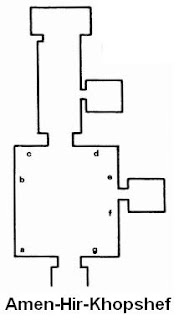 In this charming tomb Ramses III himself leads his son Amon-Hir-Khopshef into the presence of the divine gods of the underworld. The nine-year-old boy wears the side-lock of youth ,and carries the feather of truth as he obediently follows his father. The reliefs are of fine quality low painted relief, in excellently preserved color. In fact the murals of this tomb are amongst the finest on the necropolis.
The tomb comprises a large entrance hall with an unfinished annex to the right and the tomb chamber (unfinished).
On the left-hand wall, travelling clockwise, we wee the young prince following the Pharaoh Ramses III, who offers incense to Ptah (a) and then introduces his son. Afterwards he presents the boy to Duamutef and to Imsety (Imseti) (b), who conducts the pair to Isis. Note that Isis (c) looks over her shoulder to the advancing Pharaoh. She holds him by the hand.
On the right-hand wall (continuing clockwise) Ramses and his son are conducted to Hathor (d), Hapi, Qebehsenuef (e) Shu (f) and Nephthys (g) who puts her hand beneath the chin of the bereaved Pharaoh.
The corridors bear scenes from the Book of the Dead.
There was no mummy of the boy in the sarcophagus but in its place was a foetus of six months' development. Perhaps the mother miscarried due to grief at the loss of the boy. One can only speculate. The foetus is preserved in a small hermetically sealed glass in the tomb.
 Tomb of Queen Titi (Tyti)
This is not Queen Tiy, consort of Amenhotep III and mother of Akhenaten, but a queen of the Ramesside era. The tomb is damaged but some of the murals still retain startling freshness of color. The figures of the gods and demons in the tomb chamber defy the years with their brightness.
The tomb is simple, comprising an ante-chamber (I), a long passage (2) and the tomb chamber (3), which is flanked by three small chambers.
On the rear wall of the chamber flanking the tomb chamber to the right (a) is a representation of Hathor who appears in the form of a cow in a mountainous landscape. In front there is a sycamore from which Hathor, now represented in human form, pours out Nile water to revive the queen.
The chamber on the opposite side (b) contains the mummy shaft. The rear chamber (c) shows genii of the dead and various gods seated at offering tables while the queen prays to them (to left and right). On the rear wall Osiris sits enthroned with Neith and Selket before him and Nephthys, Isis and Thoth behind him.
Background:
In this valley by no means all the queens of the New Kingdom were buried. It appears that a special burial ground for the royal consorts was started only in the reign of Ramses I and royal offspring were also buried here. There are signs that previously the queens were laid to rest beside their husbands in the Valley of the Kings, but pillage of the royal tombs has made it extremely difficult for archeologists to confirm this.
There are over twenty tombs in the Valley of the Queens. Many are unfinished and entirely without decoration, resembling caves rather than sacred tomb chambers. The most impressive is that of the wife of Ramses II, Queen Nefertari, his favorite. Although her tomb may only be visited by special permission because of the deterioration of the murals, it will nevertheless be described in order to give a picture of the memorial to a Pharaoh's love. This, and the tomb constructed for the son of Ramses III, Amon-hir-
Khopshef (Amen-hir-Khopshef), who died too young to pass alone into the divine presence of the gods of the underworld, are the most important.
Tomb of Nefertari
Nefer-tari or 'Beautiful Companion' has a magnificent tomb comprising an entrance hall (I) with a side chamber (2) leading off to the right. A corridor stairway (3) leads to the burial chamber (4) which has four square pillars and, in the center, a few stairs leading to what was once the site of the sarcophagus, sunk slightly lower than the ground rock. The walls throughout the tomb are elaborately worked in low relief, partly filled with stucco and painted.
The first thing that strikes one on entry into the tomb is the extravagant use of color and its astounding brilliance. The flesh hues, white robes, black hair, bright friezes give the impression of having been newly painted. And the second thing is the realism with which the queen herself has been painted. She is graceful andsensitive and extremely beautiful. Her form, as she appears before the various deities, is accompanied by only a modest amount of text. This, despite the excessive detail of the drawings, gives the impression of simplification, somewhat as though the presence of one so beautiful spoke for itself.
On the left-hand wall of the first chamber (a) is a series of magical formulas with the queen playing. At (b) the Ka worships the rising sun between two lions which symbolize the immediate past and the immediate future. To the right at (c) and (d) the goddesses Neith and Selket receive the queen. Maat, goddess of truth, is represented at each side of the entrance to the annex (e). In the side chamber (2) on the right-hand wall (f) the queen adores seven sacred cows, the bull and four steering oars of the sky. On the facing wall (g) she makes offerings to Osiris (on the left) and Atum (on the right). On the left-hand wall (h) she stands before the ibis-headed Thoth while Heqt the frog squats before him.
In the stair-cased corridor (3) Nefertari makes offerings to Isis (on the left) and Hathor (on the right) while guardian deities protect and guide her.
The murals of the tomb chamber (4) are not in such perfect condition but represent the deceased queen again with the deities.
As usual, demons guard the gates of the underworld and the queen passes by with the aid of the sacred formulas and emblems. In this tomb the safeguards and warnings against evil, and examples of possible sufferings to those. not pure in heart, seem to have been used to the minimum. One is conscious of a path of purity through the underworld, as though the journey of Ramses II's beloved was a mere formality.
Tomb of Amen-hir-Khopshef
The tomb comprises a large entrance hall with an unfinished annex to the right and the tomb chamber (unfinished).
On the left-hand wall, travelling clockwise, we wee the young prince following the Pharaoh Ramses III, who offers incense to Ptah (a) and then introduces his son. Afterwards he presents the boy to Duamutef and to Imsety (Imseti) (b), who conducts the pair to Isis. Note that Isis (c) looks over her shoulder to the advancing Pharaoh. She holds him by the hand.
On the right-hand wall (continuing clockwise) Ramses and his son are conducted to Hathor (d), Hapi, Qebehsenuef (e) Shu (f) and Nephthys (g) who puts her hand beneath the chin of the bereaved Pharaoh.
The corridors bear scenes from the Book of the Dead.
There was no mummy of the boy in the sarcophagus but in its place was a foetus of six months' development. Perhaps the mother miscarried due to grief at the loss of the boy. One can only speculate. The foetus is preserved in a small hermetically sealed glass in the tomb.
This is not Queen Tiy, consort of Amenhotep III and mother of Akhenaten, but a queen of the Ramesside era. The tomb is damaged but some of the murals still retain startling freshness of color. The figures of the gods and demons in the tomb chamber defy the years with their brightness.
The tomb is simple, comprising an ante-chamber (I), a long passage (2) and the tomb chamber (3), which is flanked by three small chambers.
On the rear wall of the chamber flanking the tomb chamber to the right (a) is a representation of Hathor who appears in the form of a cow in a mountainous landscape. In front there is a sycamore from which Hathor, now represented in human form, pours out Nile water to revive the queen.
The chamber on the opposite side (b) contains the mummy shaft. The rear chamber (c) shows genii of the dead and various gods seated at offering tables while the queen prays to them (to left and right). On the rear wall Osiris sits enthroned with Neith and Selket before him and Nephthys, Isis and Thoth behind him.
Tags:
Amen-hir-Khopshef,
ancient,
ancient egypt,
Duamutef,
Egypt,
Heqt,
Imsety,
Isis,
Maat,
Nefertari,
Neith,
Nephthys,
Pharaoh,
Qebehsenuef,
Ramses II,
Sleket,
Titi,
Tombs,
Valley of the Queens
Tomb of Ramses III Plan -:Valley of the Kings, Egypt- Part VI
Valley of the Kings, Luxor, Egypt:
This tomb is second in size, after the Tomb of Seti I and has become known as the Tomb of the Harp-Player. Its construction differs from the regular tomb in that five small chambers lead off either side of the first and second corridors, making ten in all. Each is devoted to aspects of the Pharaoh's life. It is also interesting that the first part of the tomb - up to the third room - was built by Setnakht (or Setnakhte), father of Ramses III, and in places where the paint has fallen off his cartouches are revealed . This is the tomb, it will be remembered, where the third corridor was diverted to the right after its builders had broken into an adjacent tomb by mistake.Although the wall decorations may not be considered of the best artistic quality, their variety and richness are certainly unsurpassed. The entrance door is at the foot of a flight of steps on each side of which are small pillars with bulls' heads. Over the door is a representation of Isis and Nephthys worshiping the sun-disc. Along the first corridor are figures of Maat, goddess of integrity and truth, kneeling and sheltering with her wings the deceased Pharaoh as his body enters the tomb. On the walls are Praises of Ra. The Pharaohhimself can be seen on the left-hand wall before Harmaches (one of the forms of the Sun God) followed by the familiar sacred serpent, crocodile and two gazelles' heads.We now turn to the five small chambers leading off the left-hand side of the corridor . The first chamber (a) contains various scenes of cooking, slaughtering and baking. The second chamber (b) has, on the entrance wall to the left , the kneeling god of the Nile bestowing his gifts to seven gods of fertility which have ears of corn on their heads. On the wall to the right the Nile god is seen before the serpent-headed goddess Napret, five apron-clad royal snakes and two gods of fertility. The third chamber (c) is largely-decorated with male and female local deities with offerings. In the bottom row are kneeling Nile gods. The fourth chamber (d) has representations of the guardian spirit of the deceased on either side of the entrance, each bearing a staff ending in a royal held. The other walls show double rows of rowers, sacred serpents and sacred cattle. The fifth chamber (e) contains the representations that gave the tomb its name: on the left wall are two harpists, one before Anhor and the hawk-headed Harmaches, and the other before Shu and Atum. The text on either side of the doorway is the song they sing asking that the blessed Pharaoh might be received.
As already stated, there are five chambers on the right-hand side of the corridor. The first (f) contains a double row of sailing ships: those In the upper row ready to set sail and those in the lower with sails furled. The second chamber (g) is the Pharaoh's armory. The walls have representations of all the royal weapons and standards. At the top of the left-hand wall are standards with heads of sacred animals. At the top of the right-hand wall are standards with gods' heads. On the rear wall are a multitude of bows, arrows and quivers.
The third chamber (h) is particularly interesting if were member that this was a very wealthy Pharaoh, for it contains his treasury. On the walls are representations of furniture and ornaments, utensils and jewelery, elaborate head-rests, cushioned benches and comfortable couches that are attained by steps. The fourth
chamber (i) has rural scenes. The Pharaoh sails along a canal watching ploughing, sowing and reaping. In the fields are sacred animals . The last chamber on the right-hand side (j) is notable for its twelve different forms of Osiris, the god of the underworld.
The fourth corridor is decorated with scenes from the Book of the Dead, and leads to an ante-chamber (5) with representations of the Pharaoh In the presence of the gods of the underworld. The sloping passage (6) that follows has side galleries supported by four pillars, and a doorway on the right leading to a small chamber (7) ; here are some fine representations: on the right-hand wall (k) the Pharaoh is guided by the deities Thoth and Har-Khentkheti. On the left-hand wall (I) he presents the image of truth to Osiris, god of the underworld. On the rear wall (m) the Pharaoh stands in the presence of Osiris.
The following corridor (8) is badly damaged, as are the ante-chambers that precede the tomb chamber itself (10). This is a long oblong room with four pillars on each side and an extra chamber at each of the four corners. The actual sarcophagus is now in the French museum “Louvre”, its lid is in Cambridge, and the Pharaoh' s mummy, amongst those taken from the shaft at Deir el Bahri (Hatshepsut Temple), is now in the Cairo Museum.
Egypt: Tomb of Seti I Plan - Valley of the Kings - Part III Largest Tomb
Giovanni Belzoni, who discovered the tomb in 1817, was a circus man who originally came to Egypt to market an irrigation pump he had designed in England. The project fell through but he arranged the transportation of the colossal head of Ramses II from the Ramasseum to the British Museum in London.
|
| This is a classical tomb that far surpasses all others in the Valley of the Kings both in size and in the artistic execution of the sculptured walls. Every inch of wall space of its entire 100 meter length is covered with representations which were carried out by the finest craftsmen. |
The second corridor (2), which is staircased, has thirty-seven forms of the Sun God depicted on the upper part of the recesses on both sides. As we descend to the third corridor , Maat, goddess of truth, faces us with outstretched wings above the doorway (r). Isis is represented on the left-hand side (d), and Nephthys (Nebethet) on the right (e), and they both kneel on the hieroglyph for 'gold' and place their hands upon a seal ring. Above them, on each side of the corridor, the jackal-god Anubis can be seen. The wall reliefs here have not been completed but we can see the outlines in black, the master's touch in red, and the accuracy with which the relief is carved from the bottom up wards.Proceeding beneath Maat with her outstretched wings we pass into the third corridor (3), which has dramatic representations of the fifth hour of night from the fifth chapter of the Book of the Dead. Towards the middle of the left-hand wall (f) the sun-boat (damaged) is driven through the netherworld by seven gods and seven goddesses and in front of it march four gods and the goddess Isis. On the right-hand wall (g) the Sun God and his retinue are drawn through a land inhabited by demons and monsters (top and bottom rows) and we see a serpent with three heads, wings and human legs. But the Sun God is safe, drawn by Horus and Thoth (middle row) who carry an eye as a protection against evil. The ceiling is blackened from the candles of the early Christians who hid in the tomb, as it is believed.From the third corridor onwards the quality of the color on the reliefs is superb. We now come to a small ante-chamber (4). The walls, both to left and right, show the Pharaoh between Harmachis and Isis offering wine to Hathor. We now enter a square chamber with four pillars (s) . On the pillars themselves the Pharaoh is shown before the various deities: Isis and Nephthys (Nebethet) the sister-wife and the sister of Osiris, Harbor the goddess of joy and love who was also the goddess of Dendera to whom the cow was sacred, Selket the goddess to whom the scorpion was sacred, Horus the universal Sun God, and Harsiesis and Harmaches who were special forms of Horus; also of course Anubis, the jackal-god of embalming. The walls, especially those at the sides, have marvelous representations of the sun travelling through the fourth region of the underworld. On the rear wall (h) Osiris is enthroned before Hathor while the Pharaoh is led into his presence by the hawk-headed Horus. This is a superb mural with intricate detail and rich color. Near the corner of the left-handwall (i) the four chief races of men known at the time stand before Horus: these are Egyptians, Asiatics with pointed beards and colored aprons, four backs and four Libyans with feathers on their heads and tattooed bodies.The chamber (6), situated to the right and entered via an arrow flight of steps, was never completed. Whether this was because it was discovered that the walls were of inferior material, or as a blind to mislead grave-robbers, is not known, but the sketches on the walls are bold and compelling and show the touch of a master craftsman. The original sketch was done in red. The corrections in black were probably the work of the senior artist , after which the carvers took over. The left-hand wall (j) shows the journey during the ninth hour of the underworld: the sacred cow, ram, bird and human head guarding the procession against the fiery serpents. On the rear-wall (k) is the tenth hour with the hawk joining the protective deities and the spirits carrying arrows and lances. On the right-hand wall (I) is the eleventh hour with the condemned in the lower row. The enemies of the Sun God are being burned under the supervision of the hawk-headed Horus in strange furnaces, whilst fire-breathing goddesses stand watch with swords.
|
| (The picture above is for the ceiling of the tomb of Seti I at the Valley of the Kings) |
We descend a few more steps into a small corridor (8) which is decorated with texts of the ceremonies performed before the statue of the deceased Pharaoh in order that he may eat and drink in the hereafter. On the right-hand wall (n) is a list of offerings.
|
The picture above is of an unfinished relief work at the tomb of Seti I |
|
The picture above is for a scene from burial chamber of Seti I's tomb |
the tomb was discovered. It was made out of a single piece of alabaster, carved to a thickness of two inches and with the exquisite reliefs filled in with blue paste. This magnificent piece is comparable only to the alabaster vase found in Tutankhamun's tomb which is today in the Cairo Museum. The mummy, which was one of those found at Deir el Bahri (Hatshepsut's Temple), is in the same museum. The sarcophagus lies in the Soane Museumin in London. When Belzoni, who was commissioned to transport it, took it to the British Museum, the trustees considered the price set too high and the treasure was without a buyer until 1824 when Sir John Soane paid £2,000 for it. The decorations on the walls of the pillared portion of the hall show the journey through the first region of the underworld on the left entrance-wall (0) and through the fourth region of the underworld on the left-hand wall (p). In a small recess at the end of this wall (q) is a beautiful representation of Anubis performing theopening-of- the-mouth ceremony before Osiris. On the right-hand entrance wall (r) and the right-hand wall (s) are representations of the journey through the second region of the underworld. The vaulted ceiling has been painted with astrological figures. From early times, of course, the Egyptians had mapped out the heavens, identified some of the fixed stars and were able to determine the positions of others. This ceiling is unusual in that it has not been painted in the familiar balanced, repetitive form. Adjoining the tomb chamber are four side-rooms. The first one on the right (11) has the text of a myth that concerns the rebellion of mankind against the Sun God, their punishment and final rescue. On the rear wall is a magnificent relief of the heavenly cow of the myth supported by Shu, the god of the atmosphere,and bearing on its back two boats of the sun.
|
| The Tomb of Seti I, Book of the Dead |
The Pharaoh will overcome. With the help of the Sun God the doors of the hereafter are open to him. He will enter with his valuables and possessions; with the ability to eat and drink; and imbued with life so as to reign again. This is his ultimate hope.
Subscribe to:
Posts (Atom)