

Showing posts with label Pharaoh. Show all posts
Showing posts with label Pharaoh. Show all posts
Tomb of Khaemhat Plan- Tombs of the Nobles - Luxor, Egypt. Part IV
Also spelled Khaemhet, Toms of the Nobles, Luxor, Egypt.
 This is the tomb of the overseer of the granaries of Upper and Lower Egypt late in the reign of Amenhotep III (father of Akhenaten), a time when art and architecture were flourishing. It was also a time when religious
conceptions were undergoing a gradual change towards the worship of a single deity, the sun . The murals are in low relief and are carried out in precise and sensitive detail. This is particularly apparent in the treatment of Khaemhat's wig, with his own hair showing beneath.
The tomb comprises a large traverse chamber (1) with a niche on the left-hand side containing badly damaged statues of the deceased and the royal scribe Imhotep, a corridor (2) with scenes relating to the underworld and a second traverse chamber (3) containing three niches bearing statues of Khaemhat and his relatives. These too are in poor condition.
On the left-hand entrance wall of the first chamber at (a) is a remarkable representation of Renenutet (Renenet) ,the snake-headed goddess of the granaries. She is seated in a shrine and offerings are made to
 her by three finely sculpted male figures. The child she nurses is symbolic of the new harvest . Further along the wall (b) is the bustling port of Thebes. The masts of many corn-laden vessels, the steering oars tipped with the head of the Pharaoh, the mastheads, the rigging - all are depicted in meticulous detail.
On the rear left-hand wall (c) is a scene showing servants of the vizier bringing in cattle. At (d) are damaged figures of the Pharaoh and his vizier. At the foot of the royal canopy are nine captive tribes whilst between the lion-legs of the throne are two captives: African and Asian.
On the right-hand rear wall (e) the enthroned Pharaoh (defaced) receives homage from Khaernhat and his officials. Further along (f) Khaemhet is being decorated by the Pharaoh; according to the inscription he was so honored in the thirteenth year of the reign of Amenhotep III (Akhenaten's father).
On the right-hand entrance wall (g) are a set of agricultural scenes including measuring the land, sowing and reaping. Khaemhat's chariot is drawn up near the fields and while a sleepy driver awaits the return of his master the horses take advantage of the break to graze.
In the corridor, on the left-hand side at (h) , is a fine representation of Osiris enthroned with Hathor standing behind him.


Tomb of Nakht Plan - Tombs of the Nobles - Luxor, Egypt. Part II
Tombs of the Nobles, Luxor, Egypt.
 This is the simple tomb of the scribe of the granaries under Thutmose IV. It comprises two chambers and only the first is decorated. But in this single room are such detailed activities, executed with such infinite charm and in such a good state of repair that the tomb of Nakht will always rank as one of the finest. The more detailed the earthly activities depicted in the tomb , the easier for them to be repeated in the hereafter; that much isclear. But this tomb has, in addition, extraordinary and remarkable irrelevances that both surprise and charm.
 We will turn to the left after we enter the doorway. On the first wall (a) is a series of agricultural scenes including ploughing, digging, sowing, etc. In the upper row the deceased superintends three stages of the harvest: the measuring and winnowing of the grain , the reaping and pressing of the grain into baskets - with a charming drawing of a man leaping in the air so that the weight of his body might press the grain tightly-and, in the lower row, the laborers being organized by the deceased for ploughing in two teams. Note that the ploughman has ragged hair, the ox is piebald and that, in the midst of the strenuous work one of the workers
takes a moment's respite to drink from a wineskin on a tree.
On the rear left-hand wall (b) there is a delightful scene showing the deceased and his wife (in the lower row) being brought flowers and geese by their son whilst three women play music to them. These female musicians are sensitively painted in perfect detail. The graceful nude lute-player dances to the accompaniment. of.a
no less graceful flautist and harpist. The body of the one girl is given front-view treatment while her head is turned to speak to her colleague. Above is a blind harpist playing to guests and attended by an audience of women seated on the ground, who are apparently more interested in local gossip than in watching the dancers, and a naked young girl leaning to put perfume before the nostrils of three women. Below Nakht's chair is a bristling cat who has just stolen a feast.
On the right-hand rear wall (c) the deceased is seated with his wife in an arbor (lower row), while flowers, poultry, grapes and fish are brought to them by their servants. Servants were of course a regular feature in the homes of Egypt's noblemen. Each had a specific chore: cleaning the bed-chamber, washing the laundry,
acting as nanny.
On this same wall (c) birds are being caught in nets and plucked. The filled net is a complex of wings and colors. Grapes are being picked and turned into wine (lower rows) and in the upper row the deceased enjoys his hobbies. He is spearing fish and shooting fowl. The fishing scene was never completed. Though the fish them-selves are drawn, Nakht has no spear in hand. His wife tenderly holds an injured bird in her hand. His little daughter holds his leg to prevent him from losing balance.
It is interesting to note that, in contrast to the twelve dramatic zones of the underworld traversed by the deceased Pharaohs in their tombs in the Valley of the Kings, the deceased noblemen had simple intercourse with the gods. On each side of the entrance doorway Nakht followed by his wife and three rows of servants,
makes offerings to Amon, whose name was obliterated by Akhenaten whenever it occurred.
In the second chamber, in a shaft descending to the mummy chamber, was found a small and exquisite statue of Nakht in a kneeling position and holding an inscribed stele. This little masterpiece is now lying on the floor of the Irish Sea, on which it was being transported was sunk in World War I.
Nakht the man has emerged from the paintings in his tomb. We know about his official career with its emphasis on organization, efficiency and production, his family life with its show of harmony and plenty, his entertainments with their air of light-hearted gaiety and the pastimes that gave him most pleasure.
Pictures from the tomb of Nakht:

(His wife tenderly holds an injured bird in her hand.)

(Birds are being caught in nets and plucked. The filled net is a complex of wings and colors.)

(Three women playing music to them)

(Naked young girl leaning to put perfume before the nostrils of three women)
Tags:
ancient,
ancient egypt,
Birds,
Death,
Egypt,
Music,
Nakht,
Pharaoh,
Thutmose IV,
Tombs,
Tombs of the Nobles

400 Ptolemaic bronze coins found in Faiyum, Egypt

North of Lake of Qarun, Faiyum city, 50 miles southwest Cairo, Egypt.
2000-year-old coins were found in the Lake of Qarun, the coins date back to King Ptolemy III, whose Greek family ruled Egypt for 300 years, till Cleopatra committed suicide.
On side of the coins is inscribed with the Greek-Egyptian gold Amun-Zeus, and on the other side is the words "Ptolemy" and "King" written in Greek language. The coins weight 32 grams each.

More artifacts were found in the area, including three necklaces that the Egyptian government said "it was the first time Egyptian archeologists find Necklaces made of ostrich eggshell in Fayoum" They were found in a 42-million-year-old skeleton of a whale! Which actually is not less interesting than the discovered coins...
These items will be displayed at the New Egyptian Museum which is under construction now, close to the great Pyramids in Giza.
Tags:
ancient,
ancient egypt,
Cleopatra,
Egypt,
Egypt's Greeks,
Fayoum,
News,
Pharaoh,
Ptolemaic Era
The Valley of the Queens Plans - Luxor, Egypt.
Luxor, Egypt.
Background:
In this valley by no means all the queens of the New Kingdom were buried. It appears that a special burial ground for the royal consorts was started only in the reign of Ramses I and royal offspring were also buried here. There are signs that previously the queens were laid to rest beside their husbands in the Valley of the Kings, but pillage of the royal tombs has made it extremely difficult for archeologists to confirm this.
There are over twenty tombs in the Valley of the Queens. Many are unfinished and entirely without decoration, resembling caves rather than sacred tomb chambers. The most impressive is that of the wife of Ramses II, Queen Nefertari, his favorite. Although her tomb may only be visited by special permission because of the deterioration of the murals, it will nevertheless be described in order to give a picture of the memorial to a Pharaoh's love. This, and the tomb constructed for the son of Ramses III, Amon-hir-
Khopshef (Amen-hir-Khopshef), who died too young to pass alone into the divine presence of the gods of the underworld, are the most important.
Tomb of Nefertari
Nefer-tari or 'Beautiful Companion' has a magnificent tomb comprising an entrance hall (I) with a side chamber (2) leading off to the right. A corridor stairway (3) leads to the burial chamber (4) which has four square pillars and, in the center, a few stairs leading to what was once the site of the sarcophagus, sunk slightly lower than the ground rock. The walls throughout the tomb are elaborately worked in low relief, partly filled with stucco and painted.
 The first thing that strikes one on entry into the tomb is the extravagant use of color and its astounding brilliance. The flesh hues, white robes, black hair, bright friezes give the impression of having been newly painted. And the second thing is the realism with which the queen herself has been painted. She is graceful and
sensitive and extremely beautiful. Her form, as she appears before the various deities, is accompanied by only a modest amount of text. This, despite the excessive detail of the drawings, gives the impression of simplification, somewhat as though the presence of one so beautiful spoke for itself.
On the left-hand wall of the first chamber (a) is a series of magical formulas with the queen playing. At (b) the Ka worships the rising sun between two lions which symbolize the immediate past and the immediate future. To the right at (c) and (d) the goddesses Neith and Selket receive the queen. Maat, goddess of truth, is represented at each side of the entrance to the annex (e). In the side chamber (2) on the right-hand wall (f) the queen adores seven sacred cows, the bull and four steering oars of the sky. On the facing wall (g) she makes offerings to Osiris (on the left) and Atum (on the right). On the left-hand wall (h) she stands before the ibis-headed Thoth while Heqt the frog squats before him.
In the stair-cased corridor (3) Nefertari makes offerings to Isis (on the left) and Hathor (on the right) while guardian deities protect and guide her.
The murals of the tomb chamber (4) are not in such perfect condition but represent the deceased queen again with the deities.
As usual, demons guard the gates of the underworld and the queen passes by with the aid of the sacred formulas and emblems. In this tomb the safeguards and warnings against evil, and examples of possible sufferings to those. not pure in heart, seem to have been used to the minimum. One is conscious of a path of purity through the underworld, as though the journey of Ramses II's beloved was a mere formality.
Tomb of Amen-hir-Khopshef

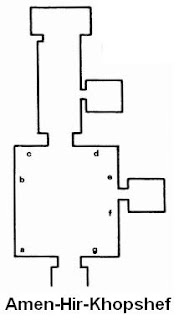
The tomb comprises a large entrance hall with an unfinished annex to the right and the tomb chamber (unfinished).
On the left-hand wall, travelling clockwise, we wee the young prince following the Pharaoh Ramses III, who offers incense to Ptah (a) and then introduces his son. Afterwards he presents the boy to Duamutef and to Imsety (Imseti) (b), who conducts the pair to Isis. Note that Isis (c) looks over her shoulder to the advancing Pharaoh. She holds him by the hand.
On the right-hand wall (continuing clockwise) Ramses and his son are conducted to Hathor (d), Hapi, Qebehsenuef (e) Shu (f) and Nephthys (g) who puts her hand beneath the chin of the bereaved Pharaoh.
The corridors bear scenes from the Book of the Dead.
There was no mummy of the boy in the sarcophagus but in its place was a foetus of six months' development. Perhaps the mother miscarried due to grief at the loss of the boy. One can only speculate. The foetus is preserved in a small hermetically sealed glass in the tomb.

This is not Queen Tiy, consort of Amenhotep III and mother of Akhenaten, but a queen of the Ramesside era. The tomb is damaged but some of the murals still retain startling freshness of color. The figures of the gods and demons in the tomb chamber defy the years with their brightness.
The tomb is simple, comprising an ante-chamber (I), a long passage (2) and the tomb chamber (3), which is flanked by three small chambers.
On the rear wall of the chamber flanking the tomb chamber to the right (a) is a representation of Hathor who appears in the form of a cow in a mountainous landscape. In front there is a sycamore from which Hathor, now represented in human form, pours out Nile water to revive the queen.
The chamber on the opposite side (b) contains the mummy shaft. The rear chamber (c) shows genii of the dead and various gods seated at offering tables while the queen prays to them (to left and right). On the rear wall Osiris sits enthroned with Neith and Selket before him and Nephthys, Isis and Thoth behind him.
Tags:
Amen-hir-Khopshef,
ancient,
ancient egypt,
Duamutef,
Egypt,
Heqt,
Imsety,
Isis,
Maat,
Nefertari,
Neith,
Nephthys,
Pharaoh,
Qebehsenuef,
Ramses II,
Sleket,
Titi,
Tombs,
Valley of the Queens
Tomb of Thutmose III Plan - Valley of the Kings - Egypt - Part IX
Valley of the Kings, Luxor, Egypt.
This is the tomb of the world's first empire builder. A steep flight of stairs across a dramatic ravine between sheer mountain faces leads to the remote entrance. It was excavated in the 18th Dynasty when the Pharaoh's chief aim was concealment. When it became evident that these precautions were useless, the tombs of the 19th  Dynasty were grouped together under an armed guard The design is simple. After the stairway a sloping corridor descends to a staircase which has broad niches on both Sides (I). Beyond this is another corridor leading to a rectangular shaft (crossed by a hand-bridge) and into a chamber (2) which has two undecorated pillars and a ceiling covered with stars. The walls bear the names of 741 different deities. The tomb chamber (3) is approached by a stairway and is In the
  form of an oval. The scenes of the underworld are mostly In excellent condition. The representations on the pillars are delightfully simplified black drawings. On the face of the first is a religious inscription and on the left-hand face (from top to bottom) are Thutmose and his queen-mother Isis in a boat, the king being suckled by Isis in the form of a tree and (below) the king being followed by his three wives and the princess Nofretere. On the third face of the pillar are demons. Demons and religious inscriptions adorn the other pillars. The sarcophagus, on an alabaster pedestal, was made of red sandstone and was found to be empty.
 Dynasty were grouped together under an armed guard The design is simple. After the stairway a sloping corridor descends to a staircase which has broad niches on both Sides (I). Beyond this is another corridor leading to a rectangular shaft (crossed by a hand-bridge) and into a chamber (2) which has two undecorated pillars and a ceiling covered with stars. The walls bear the names of 741 different deities. The tomb chamber (3) is approached by a stairway and is In the
  form of an oval. The scenes of the underworld are mostly In excellent condition. The representations on the pillars are delightfully simplified black drawings. On the face of the first is a religious inscription and on the left-hand face (from top to bottom) are Thutmose and his queen-mother Isis in a boat, the king being suckled by Isis in the form of a tree and (below) the king being followed by his three wives and the princess Nofretere. On the third face of the pillar are demons. Demons and religious inscriptions adorn the other pillars. The sarcophagus, on an alabaster pedestal, was made of red sandstone and was found to be empty.
 The Pharaoh's mummy was safely in the Deir el Bahri (Temple of Hatshepsut) shalt.
Tags:
ancient,
ancient egypt,
Death,
Egypt,
Mummy,
Nofretere,
Pharaoh,
Thutmose III,
Tombs,
Valley of the Kings
Tomb of Ramses III Plan -:Valley of the Kings, Egypt- Part VI
Valley of the Kings, Luxor, Egypt:
 This tomb is second in size, after the Tomb of Seti I and has become known as the Tomb of the Harp-Player. Its construction differs from the regular tomb in that five small chambers lead off either side of the first and second corridors, making ten in all. Each is devoted to aspects of the Pharaoh's life. It is also interesting that the first part of the tomb - up to the third room - was built by Setnakht (or Setnakhte), father of Ramses III, and in places where the paint has fallen off his cartouches are revealed . This is the tomb, it will be remembered, where the third corridor was diverted to the right after its builders had broken into an adjacent tomb by mistake.
 Although the wall decorations may not be considered of the best artistic quality, their variety and richness are certainly unsurpassed. The entrance door is at the foot of a flight of steps on each side of which are small pillars with bulls' heads. Over the door is a representation of Isis and Nephthys worshiping the sun-disc. Along the first corridor are figures of Maat, goddess of integrity and truth, kneeling and sheltering with her wings the deceased Pharaoh as his body enters the tomb. On the walls are Praises of Ra. The Pharaoh
 himself can be seen on the left-hand wall before Harmaches (one of the forms of the Sun God) followed by the familiar sacred serpent, crocodile and two gazelles' heads.
We now turn to the five small chambers leading off the left-hand side of the corridor . The first chamber (a) contains various scenes of cooking, slaughtering and baking. The second chamber (b) has, on the entrance wall to the left , the kneeling god of the Nile bestowing his gifts to seven gods of fertility which have ears of corn on their heads. On the wall to the right the Nile god is seen before the serpent-headed goddess Napret, five apron-clad royal snakes and two gods of fertility. The third chamber (c) is largely-decorated with male and female local deities with offerings. In the bottom row are kneeling Nile gods. The fourth chamber (d) has representations of the guardian spirit of the deceased on either side of the entrance, each bearing a staff ending in a royal held. The other walls show double rows of rowers, sacred serpents and sacred cattle. The fifth chamber (e) contains the representations that gave the tomb its name: on the left wall are two harpists, one before Anhor and the hawk-headed Harmaches, and the other before Shu and Atum. The text on either side of the doorway is the song they sing asking that the blessed Pharaoh might be received.
As already stated, there are five chambers on the right-hand side of the corridor. The first (f) contains a double row of sailing ships: those In the upper row ready to set sail and those in the lower with sails furled. The second chamber (g) is the Pharaoh's armory. The walls have representations of all the royal weapons and standards. At the top of the left-hand wall are standards with heads of sacred animals. At the top of the right-hand wall are standards with gods' heads. On the rear wall are a multitude of bows, arrows and quivers.
The third chamber (h) is particularly interesting if were member that this was a very wealthy Pharaoh, for it contains his treasury. On the walls are representations of furniture and ornaments, utensils and jewelery, elaborate head-rests, cushioned benches and comfortable couches that are attained by steps. The fourth
chamber (i) has rural scenes. The Pharaoh sails along a canal watching ploughing, sowing and reaping. In the fields are sacred animals . The last chamber on the right-hand side (j) is notable for its twelve different forms of Osiris, the god of the underworld.
The fourth corridor is decorated with scenes from the Book of the Dead, and leads to an ante-chamber (5) with representations of the Pharaoh In the presence of the gods of the underworld. The sloping passage (6) that follows has side galleries supported by four pillars, and a doorway on the right leading to a small chamber (7) ; here are some fine representations: on the right-hand wall (k) the Pharaoh is guided by the deities Thoth and Har-Khentkheti. On the left-hand wall (I) he presents the image of truth to Osiris, god of the underworld. On the rear wall (m) the Pharaoh stands in the presence of Osiris.
The following corridor (8) is badly damaged, as are the ante-chambers that precede the tomb chamber itself (10). This is a long oblong room with four pillars on each side and an extra chamber at each of the four corners. The actual sarcophagus is now in the French museum “Louvre”, its lid is in Cambridge, and the Pharaoh' s mummy, amongst those taken from the shaft at Deir el Bahri (Hatshepsut Temple), is now in the Cairo Museum.
Tomb of Ramses VI Plan - Valley of the Kings - Part V - Luxor, Egypt
Valley of the kings, Luxor, Egypt.

This tomb was started by Ramses V and was usurped by his successor. It has three entrance halls, two chambers, a further two corridors, an ante-chamber and the tomb chamber. The wall representations are carried out in low painted relief. The standard of craftsmanship is not high but the tomb chamber itself has one of the most important ceilings in the Valley of the Kings. In fact names and mottoes in Coptic and Greek show that this Golden Hall was an attraction from the first century A.D.
The first three corridors carry texts and representations from the Praises of Ra .On both sides of the first corridor, at (a) and (b), the deceased Pharaoh stands before the deities Harachte (Horus) and Osiris. On the right-hand side of the second corridor (c) is the barge of the Sun God with the twelve hours of night. Towards the end of the left-hand wall (d) is the figure of Osiris before whom is the boat of the Sun God. A pig (representing evil) is being driven away from it by sacred dog-headed apes. We now pass into the third corridor.

On the roof there is a painting of the goddess Nut which extends from the beginning of the corridor (3) , through the ante-chamber (4) when: her body curves to the right of the roof, and ends in the chamber (5). On the right-hand wall of the third corridor is a superb representation of Osiris under a canopy (e).
The chamber (5) has four columns and a sloping passage at the rear which is guarded by sacred winged snakes. The columns show the Pharaoh making offerings to the deities. The roof is rich in color. On the rear walls (f) and (g) are representations of the enthroned Osiris before whom the deceased burns incense.
Though the color is well-preserved, the reliefs are inferior when compared to those in the tomb of Seti I.  The following corridor (6) takes us further along the road to the underworld. On the left -hand side (h) is the journey in the fourth hour with the sacred cow (center row) and the crocodile in a boat (second row).
 The following corridor (6) takes us further along the road to the underworld. On the left -hand side (h) is the journey in the fourth hour with the sacred cow (center row) and the crocodile in a boat (second row).
The sloping corridor (7) has sacred and protective emblems and religious formulas from the book of "That which is in the Underworld" , and leads to an ante-chamber (8). On the right-hand wall (i) is the deceased Pharaoh with Maat. The left-hand wall (j) has texts from the Book of the Dead.
Dark blue and gold predominate in the tomb chamber (9). Across the vaulted ceiling 'the goddess Nut is twice represented along its entire length, in a graceful semi-circle with backs touching. This represents the morning and evening skies. Her elongated body curves to touch the earth with finger and toe, head to the west, loins to the east.
 The entire chamber is a complex of appropriate texts from the Book of the Dead. For example, on the right-hand wall (k) is a small representation (second row) of the boat of the Sun God, who is represented in the shape of a beetle with a ram's head. The boat is being worshiped by two human-headed birds and the souls of Khepri and Atum (forms of the Sun God). Below this scene (to left and right) are the beheaded condemned and above is a representation of the goddess Nut with upstrctched arms.
In the niche at the rear of the tomb chamber (l) is the barge of the Sun God held aloft in upstretched arms.
The smashed sarcophagus of the Pharaoh and his molested mummy were left onsite by the grave-robbers who violated the tomb.
Egypt: Tomb of Amenhotep II Plan - Valley of the Kings part IV
Valley of the Kings, Luxor, Egypt.

This tomb was excavated in1898. The attention of Loret, the French archeologist, was drawn to it by local farmers. It was a remarkable find. For one thing it was the first tomb ever opened in which the Pharaoh was found where he had been laid. Secondly, there was a windfall of mummies in a sealed-off chamber, including nine of royalty. Thirdly, the burial chamber proved to be one of the most beautiful, certainly the most original, in the entire Valley of the Kings. But more important, the tomb was nearly complete and contained a complete and unspoiled set of texts from the Book of the Dead.
The first corridors are rough and undecorated. They lead to a shaft (now bridged), a false burial chamber (J) created to confuse robbers, and finally to the actual tomb chamber (2). This is supported by six pillars and the sarcophagus of the Pharaoh lay in the crypt-like section at the rear. The mummy was festooned and garlanded and the sandstone sarcophagus was all that the grave-robbers had left . Everything else had been ruthlessly plundered.

As one enters the tomb chamber one is immediately struck by the originality and beauty of the decorations. The figures on the columns -for the most part depicting Amenhotep and the gods of the underworld - are outlined in black with only his crown, jewelery, belt and the surrounding decorations in color. The drawing is exquisitely fine and the blue roof is covered with stars. The walls are painted yellow and the traditional religious formulas are so drawn as to give the impression of papyrus texts having been pinned to the walls. There is not too much detail and the use of the pigment is beneficially restrained. As already explained, the Book of the Dead was a development of the magical formulas inscribed on the inside of the coffins of the Middle Kingdom. With the aid of these formulas the deceased would overcome the foes to his eternal
triumph in the underworld. Only with the magic inscriptions could he hope to make his heart (conscience) acceptable in the awesome presence of Osiris when it was weighed against the feather of truth; and only thus could he hope to live securely forever.
 On each side of the chamber are two small rooms. Three mummies lay in the first to the right (3), and in the second (4) were nine royal mummies including Thutmose IV, Amenhotep III, Seti II and Ramses IV, Ramses V and Ramses VI. All have been taken to Cairo Museum. Not surprisingly this quickly became known as the
Safety Tomb and this is undoubtedly what the priests had intended it for. When they found that Amenhotep II's tomb had been violated they reasoned that the robbers would not return to its ravaged corridors. In fact they never did. The royal personages remained in peace for centuries.
 When Loret excavated the tomb quite a controversy arose as to whether the mummy should be left on site or whether it should be removed with the others to the museum. It was finally agreed that it should remain on site but with an armed guard. Nearly three years later the tomb was rifled when, deliberately or otherwise, the backs of the guards were turned. The mummy of Amenhotep was found on the floor, in a very much poorer condition as a result of delving and prying hands in search of overlooked treasures in the folds of the cloth. There was now no question about it. The mummy of the Pharaoh was placed in Cairo Museum. The marvellous sandstone sarcophagus stands on site.

This tomb was excavated in1898. The attention of Loret, the French archeologist, was drawn to it by local farmers. It was a remarkable find. For one thing it was the first tomb ever opened in which the Pharaoh was found where he had been laid. Secondly, there was a windfall of mummies in a sealed-off chamber, including nine of royalty. Thirdly, the burial chamber proved to be one of the most beautiful, certainly the most original, in the entire Valley of the Kings. But more important, the tomb was nearly complete and contained a complete and unspoiled set of texts from the Book of the Dead.
The first corridors are rough and undecorated. They lead to a shaft (now bridged), a false burial chamber (J) created to confuse robbers, and finally to the actual tomb chamber (2). This is supported by six pillars and the sarcophagus of the Pharaoh lay in the crypt-like section at the rear. The mummy was festooned and garlanded and the sandstone sarcophagus was all that the grave-robbers had left . Everything else had been ruthlessly plundered.

As one enters the tomb chamber one is immediately struck by the originality and beauty of the decorations. The figures on the columns -for the most part depicting Amenhotep and the gods of the underworld - are outlined in black with only his crown, jewelery, belt and the surrounding decorations in color. The drawing is exquisitely fine and the blue roof is covered with stars. The walls are painted yellow and the traditional religious formulas are so drawn as to give the impression of papyrus texts having been pinned to the walls. There is not too much detail and the use of the pigment is beneficially restrained. As already explained, the Book of the Dead was a development of the magical formulas inscribed on the inside of the coffins of the Middle Kingdom. With the aid of these formulas the deceased would overcome the foes to his eternal
triumph in the underworld. Only with the magic inscriptions could he hope to make his heart (conscience) acceptable in the awesome presence of Osiris when it was weighed against the feather of truth; and only thus could he hope to live securely forever.
 On each side of the chamber are two small rooms. Three mummies lay in the first to the right (3), and in the second (4) were nine royal mummies including Thutmose IV, Amenhotep III, Seti II and Ramses IV, Ramses V and Ramses VI. All have been taken to Cairo Museum. Not surprisingly this quickly became known as the
Safety Tomb and this is undoubtedly what the priests had intended it for. When they found that Amenhotep II's tomb had been violated they reasoned that the robbers would not return to its ravaged corridors. In fact they never did. The royal personages remained in peace for centuries.
 When Loret excavated the tomb quite a controversy arose as to whether the mummy should be left on site or whether it should be removed with the others to the museum. It was finally agreed that it should remain on site but with an armed guard. Nearly three years later the tomb was rifled when, deliberately or otherwise, the backs of the guards were turned. The mummy of Amenhotep was found on the floor, in a very much poorer condition as a result of delving and prying hands in search of overlooked treasures in the folds of the cloth. There was now no question about it. The mummy of the Pharaoh was placed in Cairo Museum. The marvellous sandstone sarcophagus stands on site.
Egypt: Tomb of Tutankhamun Plan - Valley of the Kings Part II
 |
| Mask of Tutankhamun One of the Valley of the Kings' most valuable finds. |
Tutankhamun (King Tut) was the young Pharaoh who succeeded Akhenaten towards the end of the 18th Dynasty. During his nine year rule he restored Thebes as the capital and started the restoration of the worship of Amon. Apart from this all we know of him is that he met a sudden end.
Egyptologists did not seem worried that his tomb had never been found. If there were a tomb, they reasoned, it would probably be poor in content. In any case the notable American archeologist Davis had said that the Valley of the Kings had long since yielded all that it had to yield.
Lord Carnarvon, the wealthy Englishman with a passion for ancient Egypt, thought otherwise. He was convinced not only that there was a tomb but that there was a great possibility of its being intact. Howard Carter, in charge of the team, toiled year after year in the desert of the necropolis, as keen and dedicated as Carnarvon was convinced. For these two, one fruitless year merely built up hope for the next. After six seasons, during which time it was estimated that some 200,000 tons of rubble were moved, Howard Carter was finally forced to accept the fact that his predecessor had probably been right and that the valley of the Kings had no tomb to yield. It was a depressing decision and one that he could not bring himself to take. For there was one last, very remote possibility : the site immediately beneath the tomb of Ramses VI. It was covered with roughly-constructed workmen' huts. On instructions from Carter his men set about demolishing them.
 |
| Entrance of Tutankhamun's tomb Valley of the Kings |
It was 1922. At the bottom of the steps was the doorway of a tomb. As yet it wastoo early to tell whose, but the seals seemed intact. Cables were sent to Lord Carnarvon in England while preparations were made for the opening.
Whatever had been expected, or hoped for, there is no doubt that the tomb's actual contents surpassed the wildest dreams. When we gaze at the contents which now lie in Cairo Museum we can almost feel the agony of suspense, exhilaration and utter amazement that must have overwhelmed the first to see the fabulous treasures. The opening was attended by Lord Carnarvon himself, who unhappily never lived to see the full richness of the contents of the tomb, as well as by Lady Evelyn Herbert, Professor Breasted and Dr Alan Gardener.
The tomb proved to be small, but packed to bursting with furniture, emblems, utensils, ornaments, bows, arrows and walking-sticks. Comforts for the Pharaoh in the hereafter included a fly-whisk trimmed with ostrich feathers and a camp-bed folded in three parts. There were necklets, pendants, rings and car-rings, to say nothing of the shrines and sarcophagi.
 |
| The face of Tutankhamun's mummy |
Whilst the world press was focussed on Thebes it was not surprising that one imaginative journalist should attribute the death of Lord Carnarvon to 'The Pharaoh's curse-a sting from a mosquito entombed for centuries'. It added spice to an already fermenting excitement and a growing tourist trade. Vendors and photographers had a heyday in the sacred valley of the kings, while forgers were turning out 'antiquities' wholesale.
 |
| Tutankhamun's feet |
The only chamber with decorated walls is the burial chamber itself (C). The paintings are in almost perfect condition. The religious scenes and inscriptions retain the vivid color of the day they were painted. There are full-length figures on three of the walls standing beneath a dark band which represents the sky. The wall on the left (a) has representations from the Book of the Dead. One is immediately struck by the proportion of the figures, which appear top-heavy. This was of course a characteristic of the Amarna period.
 |
| Tomb of Tutankhamun's plan The Valley of the Kings |
Questions spring to the mind . Why should the walls, apart from the tomb chamber, have been so devoid of decoration when it was believed to be imperative for every stage of the journey to the underworld to be faithfully followed? Why were the contents placed in the disorder indicated in the photographs taken just after
the opening of the tomb? And how could so vast an array of splendid provisions have been completed in the short span of nine years during which the boy-king ruled? Would a young monarch have been anything but sure that time was in his favor?
The provisions for the hereafter can be easily explained. Tutankhamun was the last in the family line and his tomb was filled not merely with his own but with family treasures. Many of the pieces had been taken from the royal temples of Tel el Amarna. The priceless royal throne in Cairo Museum, for example, shows the young king being anointed by his wife against a background of the life-giving Aten, symbol of his father-in-law's heresy. So even though Tutankhamun had completely renounced the teachings of Akhenaten he carried his symbols to his grave. Many of the glazed vases and scepters clearly originated in the other capital. In addition some of the funerary objects were proved to have been made, not for Tutankhamun, but for Semnekh-Ka-Ra, Akhenaten's son-in-law and co-regent. These included one of the larger shrines, some of the mummy ornaments and the miniature canopic coffins which had for some reason been usurped and used in Tutankhamun's tomb.
 The disorder is undoubtedly indicative of hurry, as is the lack of decoration on the tomb walls. It is clear that the young king met a sudden death and was buried in haste. Murder? Suicide? Until 1969 the mummy revealed no secrets. But the results of an anthropological and skeletal examination of the Pharaoh's mummy, carried out by the Departments of Anatomy of Cairo and Liverpool Universities, are now at hand and it appears that death could have been caused by a blow on the head. Howard Carter had said that there was a 'scab' on the Pharaoh's head. Professor Harrison of Liverpool University claims that the unusual thinness of the outer skull of the mummy could have resulted from a hemorrhage beneath the membranes overlying the brain. The X-ray examination has ruled out the theory that Tutankhamun died of tuberculosis.
If the young Pharaoh proves to have been murdered after all, it raises another question. Who was guilty? Was it his tutor Eye, who coveted his young wife and probably married her after Tutankhamun's death? Or was it General Haremhab (Horemheb) who had designs on the throne and actually succeeded in seizing it from the blue-bloods at the beginning of the 19th Dynasty?

Tags:
1922,
Amarna,
ancient,
ancient egypt,
aten,
Cairo,
Curse,
Death,
Egypt,
General Haremhab,
Howard Carter,
lapis-lazuli,
Lord Carnavon,
luxor,
Pharaoh,
Semnekh-Ka-Ra,
Tombs,
Tutankhamun,
Tutor Eye


Egypt: Small and Upper Courts, Sanctuary - Hatshepsut Temple part VI Plan
Hatshepsut Temple (Deir El-Bahri), Luxor, Egypt:
 To the right of the Birth Colonnade is a small court (E) comprising twelve sixteen-sided columns in three rows, and leading to the chapel of Anubis, which has three chambers. The walls of the court have excellently preserved reliefs, though representations of the queen have all been damaged. On the right-hand wall (m) above the small recess is a scene of the monarch making a wine-offering to the hawk-headed Sokaris, god of the dead. On the rear wall offerings are made to Amon (to the left) and Anubis (to the right) with the sacrificial gifts heaped up before each.
The upper Court (F) was the part of the temple that suffered most severely at the hands of the Christian monks. It has been closed to visitors for more than a year for reconstruction. It includes a small vestibule leading to one of the few altars (C) to come down to us from antiquity on their original sites, and to a sacrificial hall (H) with reliefs adorning the walls. At the back of the court are a number of small recesses, some larger than others, and the central recess leads into the sanctuary itself which was cut directly into the cliff backing the temple. The granite portal forming the entrance dates from the time of the Ptolemies. The Sanctuary (I) comprises three chambers. The first two have vaulted ceilings and adjoining recesses. In the first chamber is a scene (on the upper reaches of the right-hand wall) of Hatshepsut, Thutmose III and their little daughter, Princess Ranofru, sacrificing to the barge of Amon. Behind them are the queen's father Thutmose I with his wife Ahmose and their little daughter Bitnofru. A similar scene, somewhat damaged, is represented on
the left-hand wall with Thutmose III kneeling. In the inner room of the sanctuary the reliefs show a marked deterioration from the worthy representations in the reign of Hatschepsut. This room was restored by Euergetes II.
As already mentioned, Hatshepsut's mummy was never found. It was neither in the tomb she constructed in the Valley of the Kings, nor in the one excavated south of the mortuary temple, nor in the shaft at Deir el Bahri, nor in the tomb of Amenhotep II , the 'Safety Tomb' . Whether she was poisoned that Thutmose III might take over the throne, stabbed by her lover, killed by officials jealous of Senmut's favor, or died a natural death remains a matter for speculation.
Tags:
Ahmose,
ancient,
ancient egypt,
Anubis,
Bitnofru,
Egypt,
Euergetes II,
God of the dead,
hatshepsut,
Pharaoh,
Ranofru,
Sokaris,
Temple,
Thutmose III
Subscribe to:
Posts (Atom)
Showing posts with label Pharaoh. Show all posts
Showing posts with label Pharaoh. Show all posts
Tomb of Khaemhat Plan- Tombs of the Nobles - Luxor, Egypt. Part IV
Also spelled Khaemhet, Toms of the Nobles, Luxor, Egypt.
This is the tomb of the overseer of the granaries of Upper and Lower Egypt late in the reign of Amenhotep III (father of Akhenaten), a time when art and architecture were flourishing. It was also a time when religious
conceptions were undergoing a gradual change towards the worship of a single deity, the sun . The murals are in low relief and are carried out in precise and sensitive detail. This is particularly apparent in the treatment of Khaemhat's wig, with his own hair showing beneath.
The tomb comprises a large traverse chamber (1) with a niche on the left-hand side containing badly damaged statues of the deceased and the royal scribe Imhotep, a corridor (2) with scenes relating to the underworld and a second traverse chamber (3) containing three niches bearing statues of Khaemhat and his relatives. These too are in poor condition.
On the left-hand entrance wall of the first chamber at (a) is a remarkable representation of Renenutet (Renenet) ,the snake-headed goddess of the granaries. She is seated in a shrine and offerings are made to
 her by three finely sculpted male figures. The child she nurses is symbolic of the new harvest . Further along the wall (b) is the bustling port of Thebes. The masts of many corn-laden vessels, the steering oars tipped with the head of the Pharaoh, the mastheads, the rigging - all are depicted in meticulous detail.
On the rear left-hand wall (c) is a scene showing servants of the vizier bringing in cattle. At (d) are damaged figures of the Pharaoh and his vizier. At the foot of the royal canopy are nine captive tribes whilst between the lion-legs of the throne are two captives: African and Asian.
On the right-hand rear wall (e) the enthroned Pharaoh (defaced) receives homage from Khaernhat and his officials. Further along (f) Khaemhet is being decorated by the Pharaoh; according to the inscription he was so honored in the thirteenth year of the reign of Amenhotep III (Akhenaten's father).
On the right-hand entrance wall (g) are a set of agricultural scenes including measuring the land, sowing and reaping. Khaemhat's chariot is drawn up near the fields and while a sleepy driver awaits the return of his master the horses take advantage of the break to graze.
In the corridor, on the left-hand side at (h) , is a fine representation of Osiris enthroned with Hathor standing behind him.


This is the tomb of the overseer of the granaries of Upper and Lower Egypt late in the reign of Amenhotep III (father of Akhenaten), a time when art and architecture were flourishing. It was also a time when religiousconceptions were undergoing a gradual change towards the worship of a single deity, the sun . The murals are in low relief and are carried out in precise and sensitive detail. This is particularly apparent in the treatment of Khaemhat's wig, with his own hair showing beneath.
The tomb comprises a large traverse chamber (1) with a niche on the left-hand side containing badly damaged statues of the deceased and the royal scribe Imhotep, a corridor (2) with scenes relating to the underworld and a second traverse chamber (3) containing three niches bearing statues of Khaemhat and his relatives. These too are in poor condition.
On the left-hand entrance wall of the first chamber at (a) is a remarkable representation of Renenutet (Renenet) ,the snake-headed goddess of the granaries. She is seated in a shrine and offerings are made to
her by three finely sculpted male figures. The child she nurses is symbolic of the new harvest . Further along the wall (b) is the bustling port of Thebes. The masts of many corn-laden vessels, the steering oars tipped with the head of the Pharaoh, the mastheads, the rigging - all are depicted in meticulous detail.On the rear left-hand wall (c) is a scene showing servants of the vizier bringing in cattle. At (d) are damaged figures of the Pharaoh and his vizier. At the foot of the royal canopy are nine captive tribes whilst between the lion-legs of the throne are two captives: African and Asian.
On the right-hand rear wall (e) the enthroned Pharaoh (defaced) receives homage from Khaernhat and his officials. Further along (f) Khaemhet is being decorated by the Pharaoh; according to the inscription he was so honored in the thirteenth year of the reign of Amenhotep III (Akhenaten's father).
On the right-hand entrance wall (g) are a set of agricultural scenes including measuring the land, sowing and reaping. Khaemhat's chariot is drawn up near the fields and while a sleepy driver awaits the return of his master the horses take advantage of the break to graze.
In the corridor, on the left-hand side at (h) , is a fine representation of Osiris enthroned with Hathor standing behind him.
Tomb of Nakht Plan - Tombs of the Nobles - Luxor, Egypt. Part II
Tombs of the Nobles, Luxor, Egypt.
 This is the simple tomb of the scribe of the granaries under Thutmose IV. It comprises two chambers and only the first is decorated. But in this single room are such detailed activities, executed with such infinite charm and in such a good state of repair that the tomb of Nakht will always rank as one of the finest. The more detailed the earthly activities depicted in the tomb , the easier for them to be repeated in the hereafter; that much isclear. But this tomb has, in addition, extraordinary and remarkable irrelevances that both surprise and charm.
We will turn to the left after we enter the doorway. On the first wall (a) is a series of agricultural scenes including ploughing, digging, sowing, etc. In the upper row the deceased superintends three stages of the harvest: the measuring and winnowing of the grain , the reaping and pressing of the grain into baskets - with a charming drawing of a man leaping in the air so that the weight of his body might press the grain tightly-and, in the lower row, the laborers being organized by the deceased for ploughing in two teams. Note that the ploughman has ragged hair, the ox is piebald and that, in the midst of the strenuous work one of the workers
takes a moment's respite to drink from a wineskin on a tree.
On the rear left-hand wall (b) there is a delightful scene showing the deceased and his wife (in the lower row) being brought flowers and geese by their son whilst three women play music to them. These female musicians are sensitively painted in perfect detail. The graceful nude lute-player dances to the accompaniment. of.a
no less graceful flautist and harpist. The body of the one girl is given front-view treatment while her head is turned to speak to her colleague. Above is a blind harpist playing to guests and attended by an audience of women seated on the ground, who are apparently more interested in local gossip than in watching the dancers, and a naked young girl leaning to put perfume before the nostrils of three women. Below Nakht's chair is a bristling cat who has just stolen a feast.
On the right-hand rear wall (c) the deceased is seated with his wife in an arbor (lower row), while flowers, poultry, grapes and fish are brought to them by their servants. Servants were of course a regular feature in the homes of Egypt's noblemen. Each had a specific chore: cleaning the bed-chamber, washing the laundry,
acting as nanny.
On this same wall (c) birds are being caught in nets and plucked. The filled net is a complex of wings and colors. Grapes are being picked and turned into wine (lower rows) and in the upper row the deceased enjoys his hobbies. He is spearing fish and shooting fowl. The fishing scene was never completed. Though the fish them-selves are drawn, Nakht has no spear in hand. His wife tenderly holds an injured bird in her hand. His little daughter holds his leg to prevent him from losing balance.
It is interesting to note that, in contrast to the twelve dramatic zones of the underworld traversed by the deceased Pharaohs in their tombs in the Valley of the Kings, the deceased noblemen had simple intercourse with the gods. On each side of the entrance doorway Nakht followed by his wife and three rows of servants,
makes offerings to Amon, whose name was obliterated by Akhenaten whenever it occurred.
In the second chamber, in a shaft descending to the mummy chamber, was found a small and exquisite statue of Nakht in a kneeling position and holding an inscribed stele. This little masterpiece is now lying on the floor of the Irish Sea, on which it was being transported was sunk in World War I.
Nakht the man has emerged from the paintings in his tomb. We know about his official career with its emphasis on organization, efficiency and production, his family life with its show of harmony and plenty, his entertainments with their air of light-hearted gaiety and the pastimes that gave him most pleasure.
Pictures from the tomb of Nakht:


This is the simple tomb of the scribe of the granaries under Thutmose IV. It comprises two chambers and only the first is decorated. But in this single room are such detailed activities, executed with such infinite charm and in such a good state of repair that the tomb of Nakht will always rank as one of the finest. The more detailed the earthly activities depicted in the tomb , the easier for them to be repeated in the hereafter; that much isclear. But this tomb has, in addition, extraordinary and remarkable irrelevances that both surprise and charm.We will turn to the left after we enter the doorway. On the first wall (a) is a series of agricultural scenes including ploughing, digging, sowing, etc. In the upper row the deceased superintends three stages of the harvest: the measuring and winnowing of the grain , the reaping and pressing of the grain into baskets - with a charming drawing of a man leaping in the air so that the weight of his body might press the grain tightly-and, in the lower row, the laborers being organized by the deceased for ploughing in two teams. Note that the ploughman has ragged hair, the ox is piebald and that, in the midst of the strenuous work one of the workerstakes a moment's respite to drink from a wineskin on a tree.
On the rear left-hand wall (b) there is a delightful scene showing the deceased and his wife (in the lower row) being brought flowers and geese by their son whilst three women play music to them. These female musicians are sensitively painted in perfect detail. The graceful nude lute-player dances to the accompaniment. of.a
no less graceful flautist and harpist. The body of the one girl is given front-view treatment while her head is turned to speak to her colleague. Above is a blind harpist playing to guests and attended by an audience of women seated on the ground, who are apparently more interested in local gossip than in watching the dancers, and a naked young girl leaning to put perfume before the nostrils of three women. Below Nakht's chair is a bristling cat who has just stolen a feast.
On the right-hand rear wall (c) the deceased is seated with his wife in an arbor (lower row), while flowers, poultry, grapes and fish are brought to them by their servants. Servants were of course a regular feature in the homes of Egypt's noblemen. Each had a specific chore: cleaning the bed-chamber, washing the laundry,
acting as nanny.
On this same wall (c) birds are being caught in nets and plucked. The filled net is a complex of wings and colors. Grapes are being picked and turned into wine (lower rows) and in the upper row the deceased enjoys his hobbies. He is spearing fish and shooting fowl. The fishing scene was never completed. Though the fish them-selves are drawn, Nakht has no spear in hand. His wife tenderly holds an injured bird in her hand. His little daughter holds his leg to prevent him from losing balance.
It is interesting to note that, in contrast to the twelve dramatic zones of the underworld traversed by the deceased Pharaohs in their tombs in the Valley of the Kings, the deceased noblemen had simple intercourse with the gods. On each side of the entrance doorway Nakht followed by his wife and three rows of servants,
makes offerings to Amon, whose name was obliterated by Akhenaten whenever it occurred.
In the second chamber, in a shaft descending to the mummy chamber, was found a small and exquisite statue of Nakht in a kneeling position and holding an inscribed stele. This little masterpiece is now lying on the floor of the Irish Sea, on which it was being transported was sunk in World War I.
Nakht the man has emerged from the paintings in his tomb. We know about his official career with its emphasis on organization, efficiency and production, his family life with its show of harmony and plenty, his entertainments with their air of light-hearted gaiety and the pastimes that gave him most pleasure.
Pictures from the tomb of Nakht:
(His wife tenderly holds an injured bird in her hand.)
(Birds are being caught in nets and plucked. The filled net is a complex of wings and colors.)
(Three women playing music to them)
(Naked young girl leaning to put perfume before the nostrils of three women)
Tags:
ancient,
ancient egypt,
Birds,
Death,
Egypt,
Music,
Nakht,
Pharaoh,
Thutmose IV,
Tombs,
Tombs of the Nobles
400 Ptolemaic bronze coins found in Faiyum, Egypt
North of Lake of Qarun, Faiyum city, 50 miles southwest Cairo, Egypt.
2000-year-old coins were found in the Lake of Qarun, the coins date back to King Ptolemy III, whose Greek family ruled Egypt for 300 years, till Cleopatra committed suicide.
On side of the coins is inscribed with the Greek-Egyptian gold Amun-Zeus, and on the other side is the words "Ptolemy" and "King" written in Greek language. The coins weight 32 grams each.
More artifacts were found in the area, including three necklaces that the Egyptian government said "it was the first time Egyptian archeologists find Necklaces made of ostrich eggshell in Fayoum" They were found in a 42-million-year-old skeleton of a whale! Which actually is not less interesting than the discovered coins...
These items will be displayed at the New Egyptian Museum which is under construction now, close to the great Pyramids in Giza.
Tags:
ancient,
ancient egypt,
Cleopatra,
Egypt,
Egypt's Greeks,
Fayoum,
News,
Pharaoh,
Ptolemaic Era
The Valley of the Queens Plans - Luxor, Egypt.
Luxor, Egypt.
Background:
In this valley by no means all the queens of the New Kingdom were buried. It appears that a special burial ground for the royal consorts was started only in the reign of Ramses I and royal offspring were also buried here. There are signs that previously the queens were laid to rest beside their husbands in the Valley of the Kings, but pillage of the royal tombs has made it extremely difficult for archeologists to confirm this.
There are over twenty tombs in the Valley of the Queens. Many are unfinished and entirely without decoration, resembling caves rather than sacred tomb chambers. The most impressive is that of the wife of Ramses II, Queen Nefertari, his favorite. Although her tomb may only be visited by special permission because of the deterioration of the murals, it will nevertheless be described in order to give a picture of the memorial to a Pharaoh's love. This, and the tomb constructed for the son of Ramses III, Amon-hir-
Khopshef (Amen-hir-Khopshef), who died too young to pass alone into the divine presence of the gods of the underworld, are the most important.
Tomb of Nefertari
Nefer-tari or 'Beautiful Companion' has a magnificent tomb comprising an entrance hall (I) with a side chamber (2) leading off to the right. A corridor stairway (3) leads to the burial chamber (4) which has four square pillars and, in the center, a few stairs leading to what was once the site of the sarcophagus, sunk slightly lower than the ground rock. The walls throughout the tomb are elaborately worked in low relief, partly filled with stucco and painted.
 The first thing that strikes one on entry into the tomb is the extravagant use of color and its astounding brilliance. The flesh hues, white robes, black hair, bright friezes give the impression of having been newly painted. And the second thing is the realism with which the queen herself has been painted. She is graceful and
sensitive and extremely beautiful. Her form, as she appears before the various deities, is accompanied by only a modest amount of text. This, despite the excessive detail of the drawings, gives the impression of simplification, somewhat as though the presence of one so beautiful spoke for itself.
On the left-hand wall of the first chamber (a) is a series of magical formulas with the queen playing. At (b) the Ka worships the rising sun between two lions which symbolize the immediate past and the immediate future. To the right at (c) and (d) the goddesses Neith and Selket receive the queen. Maat, goddess of truth, is represented at each side of the entrance to the annex (e). In the side chamber (2) on the right-hand wall (f) the queen adores seven sacred cows, the bull and four steering oars of the sky. On the facing wall (g) she makes offerings to Osiris (on the left) and Atum (on the right). On the left-hand wall (h) she stands before the ibis-headed Thoth while Heqt the frog squats before him.
In the stair-cased corridor (3) Nefertari makes offerings to Isis (on the left) and Hathor (on the right) while guardian deities protect and guide her.
The murals of the tomb chamber (4) are not in such perfect condition but represent the deceased queen again with the deities.
As usual, demons guard the gates of the underworld and the queen passes by with the aid of the sacred formulas and emblems. In this tomb the safeguards and warnings against evil, and examples of possible sufferings to those. not pure in heart, seem to have been used to the minimum. One is conscious of a path of purity through the underworld, as though the journey of Ramses II's beloved was a mere formality.
Tomb of Amen-hir-Khopshef
 In this charming tomb Ramses III himself leads his son Amon-Hir-Khopshef into the presence of the divine gods of the underworld. The nine-year-old boy wears the side-lock of youth ,and carries the feather of truth as he obediently follows his father. The reliefs are of fine quality low painted relief, in excellently preserved color. In fact the murals of this tomb are amongst the finest on the necropolis.
The tomb comprises a large entrance hall with an unfinished annex to the right and the tomb chamber (unfinished).
On the left-hand wall, travelling clockwise, we wee the young prince following the Pharaoh Ramses III, who offers incense to Ptah (a) and then introduces his son. Afterwards he presents the boy to Duamutef and to Imsety (Imseti) (b), who conducts the pair to Isis. Note that Isis (c) looks over her shoulder to the advancing Pharaoh. She holds him by the hand.
On the right-hand wall (continuing clockwise) Ramses and his son are conducted to Hathor (d), Hapi, Qebehsenuef (e) Shu (f) and Nephthys (g) who puts her hand beneath the chin of the bereaved Pharaoh.
The corridors bear scenes from the Book of the Dead.
There was no mummy of the boy in the sarcophagus but in its place was a foetus of six months' development. Perhaps the mother miscarried due to grief at the loss of the boy. One can only speculate. The foetus is preserved in a small hermetically sealed glass in the tomb.
 Tomb of Queen Titi (Tyti)
This is not Queen Tiy, consort of Amenhotep III and mother of Akhenaten, but a queen of the Ramesside era. The tomb is damaged but some of the murals still retain startling freshness of color. The figures of the gods and demons in the tomb chamber defy the years with their brightness.
The tomb is simple, comprising an ante-chamber (I), a long passage (2) and the tomb chamber (3), which is flanked by three small chambers.
On the rear wall of the chamber flanking the tomb chamber to the right (a) is a representation of Hathor who appears in the form of a cow in a mountainous landscape. In front there is a sycamore from which Hathor, now represented in human form, pours out Nile water to revive the queen.
The chamber on the opposite side (b) contains the mummy shaft. The rear chamber (c) shows genii of the dead and various gods seated at offering tables while the queen prays to them (to left and right). On the rear wall Osiris sits enthroned with Neith and Selket before him and Nephthys, Isis and Thoth behind him.
Background:
In this valley by no means all the queens of the New Kingdom were buried. It appears that a special burial ground for the royal consorts was started only in the reign of Ramses I and royal offspring were also buried here. There are signs that previously the queens were laid to rest beside their husbands in the Valley of the Kings, but pillage of the royal tombs has made it extremely difficult for archeologists to confirm this.
There are over twenty tombs in the Valley of the Queens. Many are unfinished and entirely without decoration, resembling caves rather than sacred tomb chambers. The most impressive is that of the wife of Ramses II, Queen Nefertari, his favorite. Although her tomb may only be visited by special permission because of the deterioration of the murals, it will nevertheless be described in order to give a picture of the memorial to a Pharaoh's love. This, and the tomb constructed for the son of Ramses III, Amon-hir-
Khopshef (Amen-hir-Khopshef), who died too young to pass alone into the divine presence of the gods of the underworld, are the most important.
Tomb of Nefertari
Nefer-tari or 'Beautiful Companion' has a magnificent tomb comprising an entrance hall (I) with a side chamber (2) leading off to the right. A corridor stairway (3) leads to the burial chamber (4) which has four square pillars and, in the center, a few stairs leading to what was once the site of the sarcophagus, sunk slightly lower than the ground rock. The walls throughout the tomb are elaborately worked in low relief, partly filled with stucco and painted.
The first thing that strikes one on entry into the tomb is the extravagant use of color and its astounding brilliance. The flesh hues, white robes, black hair, bright friezes give the impression of having been newly painted. And the second thing is the realism with which the queen herself has been painted. She is graceful andsensitive and extremely beautiful. Her form, as she appears before the various deities, is accompanied by only a modest amount of text. This, despite the excessive detail of the drawings, gives the impression of simplification, somewhat as though the presence of one so beautiful spoke for itself.
On the left-hand wall of the first chamber (a) is a series of magical formulas with the queen playing. At (b) the Ka worships the rising sun between two lions which symbolize the immediate past and the immediate future. To the right at (c) and (d) the goddesses Neith and Selket receive the queen. Maat, goddess of truth, is represented at each side of the entrance to the annex (e). In the side chamber (2) on the right-hand wall (f) the queen adores seven sacred cows, the bull and four steering oars of the sky. On the facing wall (g) she makes offerings to Osiris (on the left) and Atum (on the right). On the left-hand wall (h) she stands before the ibis-headed Thoth while Heqt the frog squats before him.
In the stair-cased corridor (3) Nefertari makes offerings to Isis (on the left) and Hathor (on the right) while guardian deities protect and guide her.
The murals of the tomb chamber (4) are not in such perfect condition but represent the deceased queen again with the deities.
As usual, demons guard the gates of the underworld and the queen passes by with the aid of the sacred formulas and emblems. In this tomb the safeguards and warnings against evil, and examples of possible sufferings to those. not pure in heart, seem to have been used to the minimum. One is conscious of a path of purity through the underworld, as though the journey of Ramses II's beloved was a mere formality.
Tomb of Amen-hir-Khopshef
The tomb comprises a large entrance hall with an unfinished annex to the right and the tomb chamber (unfinished).
On the left-hand wall, travelling clockwise, we wee the young prince following the Pharaoh Ramses III, who offers incense to Ptah (a) and then introduces his son. Afterwards he presents the boy to Duamutef and to Imsety (Imseti) (b), who conducts the pair to Isis. Note that Isis (c) looks over her shoulder to the advancing Pharaoh. She holds him by the hand.
On the right-hand wall (continuing clockwise) Ramses and his son are conducted to Hathor (d), Hapi, Qebehsenuef (e) Shu (f) and Nephthys (g) who puts her hand beneath the chin of the bereaved Pharaoh.
The corridors bear scenes from the Book of the Dead.
There was no mummy of the boy in the sarcophagus but in its place was a foetus of six months' development. Perhaps the mother miscarried due to grief at the loss of the boy. One can only speculate. The foetus is preserved in a small hermetically sealed glass in the tomb.
This is not Queen Tiy, consort of Amenhotep III and mother of Akhenaten, but a queen of the Ramesside era. The tomb is damaged but some of the murals still retain startling freshness of color. The figures of the gods and demons in the tomb chamber defy the years with their brightness.
The tomb is simple, comprising an ante-chamber (I), a long passage (2) and the tomb chamber (3), which is flanked by three small chambers.
On the rear wall of the chamber flanking the tomb chamber to the right (a) is a representation of Hathor who appears in the form of a cow in a mountainous landscape. In front there is a sycamore from which Hathor, now represented in human form, pours out Nile water to revive the queen.
The chamber on the opposite side (b) contains the mummy shaft. The rear chamber (c) shows genii of the dead and various gods seated at offering tables while the queen prays to them (to left and right). On the rear wall Osiris sits enthroned with Neith and Selket before him and Nephthys, Isis and Thoth behind him.
Tags:
Amen-hir-Khopshef,
ancient,
ancient egypt,
Duamutef,
Egypt,
Heqt,
Imsety,
Isis,
Maat,
Nefertari,
Neith,
Nephthys,
Pharaoh,
Qebehsenuef,
Ramses II,
Sleket,
Titi,
Tombs,
Valley of the Queens
Tomb of Thutmose III Plan - Valley of the Kings - Egypt - Part IX
Valley of the Kings, Luxor, Egypt.
This is the tomb of the world's first empire builder. A steep flight of stairs across a dramatic ravine between sheer mountain faces leads to the remote entrance. It was excavated in the 18th Dynasty when the Pharaoh's chief aim was concealment. When it became evident that these precautions were useless, the tombs of the 19th Dynasty were grouped together under an armed guard The design is simple. After the stairway a sloping corridor descends to a staircase which has broad niches on both Sides (I). Beyond this is another corridor leading to a rectangular shaft (crossed by a hand-bridge) and into a chamber (2) which has two undecorated pillars and a ceiling covered with stars. The walls bear the names of 741 different deities. The tomb chamber (3) is approached by a stairway and is In the form of an oval. The scenes of the underworld are mostly In excellent condition. The representations on the pillars are delightfully simplified black drawings. On the face of the first is a religious inscription and on the left-hand face (from top to bottom) are Thutmose and his queen-mother Isis in a boat, the king being suckled by Isis in the form of a tree and (below) the king being followed by his three wives and the princess Nofretere. On the third face of the pillar are demons. Demons and religious inscriptions adorn the other pillars. The sarcophagus, on an alabaster pedestal, was made of red sandstone and was found to be empty.
Dynasty were grouped together under an armed guard The design is simple. After the stairway a sloping corridor descends to a staircase which has broad niches on both Sides (I). Beyond this is another corridor leading to a rectangular shaft (crossed by a hand-bridge) and into a chamber (2) which has two undecorated pillars and a ceiling covered with stars. The walls bear the names of 741 different deities. The tomb chamber (3) is approached by a stairway and is In the form of an oval. The scenes of the underworld are mostly In excellent condition. The representations on the pillars are delightfully simplified black drawings. On the face of the first is a religious inscription and on the left-hand face (from top to bottom) are Thutmose and his queen-mother Isis in a boat, the king being suckled by Isis in the form of a tree and (below) the king being followed by his three wives and the princess Nofretere. On the third face of the pillar are demons. Demons and religious inscriptions adorn the other pillars. The sarcophagus, on an alabaster pedestal, was made of red sandstone and was found to be empty.The Pharaoh's mummy was safely in the Deir el Bahri (Temple of Hatshepsut) shalt.
Tags:
ancient,
ancient egypt,
Death,
Egypt,
Mummy,
Nofretere,
Pharaoh,
Thutmose III,
Tombs,
Valley of the Kings
Tomb of Ramses III Plan -:Valley of the Kings, Egypt- Part VI
Valley of the Kings, Luxor, Egypt:
This tomb is second in size, after the Tomb of Seti I and has become known as the Tomb of the Harp-Player. Its construction differs from the regular tomb in that five small chambers lead off either side of the first and second corridors, making ten in all. Each is devoted to aspects of the Pharaoh's life. It is also interesting that the first part of the tomb - up to the third room - was built by Setnakht (or Setnakhte), father of Ramses III, and in places where the paint has fallen off his cartouches are revealed . This is the tomb, it will be remembered, where the third corridor was diverted to the right after its builders had broken into an adjacent tomb by mistake.Although the wall decorations may not be considered of the best artistic quality, their variety and richness are certainly unsurpassed. The entrance door is at the foot of a flight of steps on each side of which are small pillars with bulls' heads. Over the door is a representation of Isis and Nephthys worshiping the sun-disc. Along the first corridor are figures of Maat, goddess of integrity and truth, kneeling and sheltering with her wings the deceased Pharaoh as his body enters the tomb. On the walls are Praises of Ra. The Pharaohhimself can be seen on the left-hand wall before Harmaches (one of the forms of the Sun God) followed by the familiar sacred serpent, crocodile and two gazelles' heads.We now turn to the five small chambers leading off the left-hand side of the corridor . The first chamber (a) contains various scenes of cooking, slaughtering and baking. The second chamber (b) has, on the entrance wall to the left , the kneeling god of the Nile bestowing his gifts to seven gods of fertility which have ears of corn on their heads. On the wall to the right the Nile god is seen before the serpent-headed goddess Napret, five apron-clad royal snakes and two gods of fertility. The third chamber (c) is largely-decorated with male and female local deities with offerings. In the bottom row are kneeling Nile gods. The fourth chamber (d) has representations of the guardian spirit of the deceased on either side of the entrance, each bearing a staff ending in a royal held. The other walls show double rows of rowers, sacred serpents and sacred cattle. The fifth chamber (e) contains the representations that gave the tomb its name: on the left wall are two harpists, one before Anhor and the hawk-headed Harmaches, and the other before Shu and Atum. The text on either side of the doorway is the song they sing asking that the blessed Pharaoh might be received.
As already stated, there are five chambers on the right-hand side of the corridor. The first (f) contains a double row of sailing ships: those In the upper row ready to set sail and those in the lower with sails furled. The second chamber (g) is the Pharaoh's armory. The walls have representations of all the royal weapons and standards. At the top of the left-hand wall are standards with heads of sacred animals. At the top of the right-hand wall are standards with gods' heads. On the rear wall are a multitude of bows, arrows and quivers.
The third chamber (h) is particularly interesting if were member that this was a very wealthy Pharaoh, for it contains his treasury. On the walls are representations of furniture and ornaments, utensils and jewelery, elaborate head-rests, cushioned benches and comfortable couches that are attained by steps. The fourth
chamber (i) has rural scenes. The Pharaoh sails along a canal watching ploughing, sowing and reaping. In the fields are sacred animals . The last chamber on the right-hand side (j) is notable for its twelve different forms of Osiris, the god of the underworld.
The fourth corridor is decorated with scenes from the Book of the Dead, and leads to an ante-chamber (5) with representations of the Pharaoh In the presence of the gods of the underworld. The sloping passage (6) that follows has side galleries supported by four pillars, and a doorway on the right leading to a small chamber (7) ; here are some fine representations: on the right-hand wall (k) the Pharaoh is guided by the deities Thoth and Har-Khentkheti. On the left-hand wall (I) he presents the image of truth to Osiris, god of the underworld. On the rear wall (m) the Pharaoh stands in the presence of Osiris.
The following corridor (8) is badly damaged, as are the ante-chambers that precede the tomb chamber itself (10). This is a long oblong room with four pillars on each side and an extra chamber at each of the four corners. The actual sarcophagus is now in the French museum “Louvre”, its lid is in Cambridge, and the Pharaoh' s mummy, amongst those taken from the shaft at Deir el Bahri (Hatshepsut Temple), is now in the Cairo Museum.
Tomb of Ramses VI Plan - Valley of the Kings - Part V - Luxor, Egypt
Valley of the kings, Luxor, Egypt.
This tomb was started by Ramses V and was usurped by his successor. It has three entrance halls, two chambers, a further two corridors, an ante-chamber and the tomb chamber. The wall representations are carried out in low painted relief. The standard of craftsmanship is not high but the tomb chamber itself has one of the most important ceilings in the Valley of the Kings. In fact names and mottoes in Coptic and Greek show that this Golden Hall was an attraction from the first century A.D.
The first three corridors carry texts and representations from the Praises of Ra .On both sides of the first corridor, at (a) and (b), the deceased Pharaoh stands before the deities Harachte (Horus) and Osiris. On the right-hand side of the second corridor (c) is the barge of the Sun God with the twelve hours of night. Towards the end of the left-hand wall (d) is the figure of Osiris before whom is the boat of the Sun God. A pig (representing evil) is being driven away from it by sacred dog-headed apes. We now pass into the third corridor.
On the roof there is a painting of the goddess Nut which extends from the beginning of the corridor (3) , through the ante-chamber (4) when: her body curves to the right of the roof, and ends in the chamber (5). On the right-hand wall of the third corridor is a superb representation of Osiris under a canopy (e).
The chamber (5) has four columns and a sloping passage at the rear which is guarded by sacred winged snakes. The columns show the Pharaoh making offerings to the deities. The roof is rich in color. On the rear walls (f) and (g) are representations of the enthroned Osiris before whom the deceased burns incense.
Though the color is well-preserved, the reliefs are inferior when compared to those in the tomb of Seti I. The following corridor (6) takes us further along the road to the underworld. On the left -hand side (h) is the journey in the fourth hour with the sacred cow (center row) and the crocodile in a boat (second row).
The following corridor (6) takes us further along the road to the underworld. On the left -hand side (h) is the journey in the fourth hour with the sacred cow (center row) and the crocodile in a boat (second row).
The sloping corridor (7) has sacred and protective emblems and religious formulas from the book of "That which is in the Underworld" , and leads to an ante-chamber (8). On the right-hand wall (i) is the deceased Pharaoh with Maat. The left-hand wall (j) has texts from the Book of the Dead.
Dark blue and gold predominate in the tomb chamber (9). Across the vaulted ceiling 'the goddess Nut is twice represented along its entire length, in a graceful semi-circle with backs touching. This represents the morning and evening skies. Her elongated body curves to touch the earth with finger and toe, head to the west, loins to the east.
The entire chamber is a complex of appropriate texts from the Book of the Dead. For example, on the right-hand wall (k) is a small representation (second row) of the boat of the Sun God, who is represented in the shape of a beetle with a ram's head. The boat is being worshiped by two human-headed birds and the souls of Khepri and Atum (forms of the Sun God). Below this scene (to left and right) are the beheaded condemned and above is a representation of the goddess Nut with upstrctched arms.
In the niche at the rear of the tomb chamber (l) is the barge of the Sun God held aloft in upstretched arms.
The smashed sarcophagus of the Pharaoh and his molested mummy were left onsite by the grave-robbers who violated the tomb.
Egypt: Tomb of Amenhotep II Plan - Valley of the Kings part IV
Valley of the Kings, Luxor, Egypt.
This tomb was excavated in1898. The attention of Loret, the French archeologist, was drawn to it by local farmers. It was a remarkable find. For one thing it was the first tomb ever opened in which the Pharaoh was found where he had been laid. Secondly, there was a windfall of mummies in a sealed-off chamber, including nine of royalty. Thirdly, the burial chamber proved to be one of the most beautiful, certainly the most original, in the entire Valley of the Kings. But more important, the tomb was nearly complete and contained a complete and unspoiled set of texts from the Book of the Dead.
The first corridors are rough and undecorated. They lead to a shaft (now bridged), a false burial chamber (J) created to confuse robbers, and finally to the actual tomb chamber (2). This is supported by six pillars and the sarcophagus of the Pharaoh lay in the crypt-like section at the rear. The mummy was festooned and garlanded and the sandstone sarcophagus was all that the grave-robbers had left . Everything else had been ruthlessly plundered.
As one enters the tomb chamber one is immediately struck by the originality and beauty of the decorations. The figures on the columns -for the most part depicting Amenhotep and the gods of the underworld - are outlined in black with only his crown, jewelery, belt and the surrounding decorations in color. The drawing is exquisitely fine and the blue roof is covered with stars. The walls are painted yellow and the traditional religious formulas are so drawn as to give the impression of papyrus texts having been pinned to the walls. There is not too much detail and the use of the pigment is beneficially restrained. As already explained, the Book of the Dead was a development of the magical formulas inscribed on the inside of the coffins of the Middle Kingdom. With the aid of these formulas the deceased would overcome the foes to his eternal
triumph in the underworld. Only with the magic inscriptions could he hope to make his heart (conscience) acceptable in the awesome presence of Osiris when it was weighed against the feather of truth; and only thus could he hope to live securely forever.
On each side of the chamber are two small rooms. Three mummies lay in the first to the right (3), and in the second (4) were nine royal mummies including Thutmose IV, Amenhotep III, Seti II and Ramses IV, Ramses V and Ramses VI. All have been taken to Cairo Museum. Not surprisingly this quickly became known as the
Safety Tomb and this is undoubtedly what the priests had intended it for. When they found that Amenhotep II's tomb had been violated they reasoned that the robbers would not return to its ravaged corridors. In fact they never did. The royal personages remained in peace for centuries.
When Loret excavated the tomb quite a controversy arose as to whether the mummy should be left on site or whether it should be removed with the others to the museum. It was finally agreed that it should remain on site but with an armed guard. Nearly three years later the tomb was rifled when, deliberately or otherwise, the backs of the guards were turned. The mummy of Amenhotep was found on the floor, in a very much poorer condition as a result of delving and prying hands in search of overlooked treasures in the folds of the cloth. There was now no question about it. The mummy of the Pharaoh was placed in Cairo Museum. The marvellous sandstone sarcophagus stands on site.
This tomb was excavated in1898. The attention of Loret, the French archeologist, was drawn to it by local farmers. It was a remarkable find. For one thing it was the first tomb ever opened in which the Pharaoh was found where he had been laid. Secondly, there was a windfall of mummies in a sealed-off chamber, including nine of royalty. Thirdly, the burial chamber proved to be one of the most beautiful, certainly the most original, in the entire Valley of the Kings. But more important, the tomb was nearly complete and contained a complete and unspoiled set of texts from the Book of the Dead.
The first corridors are rough and undecorated. They lead to a shaft (now bridged), a false burial chamber (J) created to confuse robbers, and finally to the actual tomb chamber (2). This is supported by six pillars and the sarcophagus of the Pharaoh lay in the crypt-like section at the rear. The mummy was festooned and garlanded and the sandstone sarcophagus was all that the grave-robbers had left . Everything else had been ruthlessly plundered.
As one enters the tomb chamber one is immediately struck by the originality and beauty of the decorations. The figures on the columns -for the most part depicting Amenhotep and the gods of the underworld - are outlined in black with only his crown, jewelery, belt and the surrounding decorations in color. The drawing is exquisitely fine and the blue roof is covered with stars. The walls are painted yellow and the traditional religious formulas are so drawn as to give the impression of papyrus texts having been pinned to the walls. There is not too much detail and the use of the pigment is beneficially restrained. As already explained, the Book of the Dead was a development of the magical formulas inscribed on the inside of the coffins of the Middle Kingdom. With the aid of these formulas the deceased would overcome the foes to his eternal
triumph in the underworld. Only with the magic inscriptions could he hope to make his heart (conscience) acceptable in the awesome presence of Osiris when it was weighed against the feather of truth; and only thus could he hope to live securely forever.
On each side of the chamber are two small rooms. Three mummies lay in the first to the right (3), and in the second (4) were nine royal mummies including Thutmose IV, Amenhotep III, Seti II and Ramses IV, Ramses V and Ramses VI. All have been taken to Cairo Museum. Not surprisingly this quickly became known as theSafety Tomb and this is undoubtedly what the priests had intended it for. When they found that Amenhotep II's tomb had been violated they reasoned that the robbers would not return to its ravaged corridors. In fact they never did. The royal personages remained in peace for centuries.
When Loret excavated the tomb quite a controversy arose as to whether the mummy should be left on site or whether it should be removed with the others to the museum. It was finally agreed that it should remain on site but with an armed guard. Nearly three years later the tomb was rifled when, deliberately or otherwise, the backs of the guards were turned. The mummy of Amenhotep was found on the floor, in a very much poorer condition as a result of delving and prying hands in search of overlooked treasures in the folds of the cloth. There was now no question about it. The mummy of the Pharaoh was placed in Cairo Museum. The marvellous sandstone sarcophagus stands on site.Egypt: Tomb of Tutankhamun Plan - Valley of the Kings Part II
|
| Mask of Tutankhamun One of the Valley of the Kings' most valuable finds. |
Tutankhamun (King Tut) was the young Pharaoh who succeeded Akhenaten towards the end of the 18th Dynasty. During his nine year rule he restored Thebes as the capital and started the restoration of the worship of Amon. Apart from this all we know of him is that he met a sudden end.
Egyptologists did not seem worried that his tomb had never been found. If there were a tomb, they reasoned, it would probably be poor in content. In any case the notable American archeologist Davis had said that the Valley of the Kings had long since yielded all that it had to yield.
Lord Carnarvon, the wealthy Englishman with a passion for ancient Egypt, thought otherwise. He was convinced not only that there was a tomb but that there was a great possibility of its being intact. Howard Carter, in charge of the team, toiled year after year in the desert of the necropolis, as keen and dedicated as Carnarvon was convinced. For these two, one fruitless year merely built up hope for the next. After six seasons, during which time it was estimated that some 200,000 tons of rubble were moved, Howard Carter was finally forced to accept the fact that his predecessor had probably been right and that the valley of the Kings had no tomb to yield. It was a depressing decision and one that he could not bring himself to take. For there was one last, very remote possibility : the site immediately beneath the tomb of Ramses VI. It was covered with roughly-constructed workmen' huts. On instructions from Carter his men set about demolishing them.
|
| Entrance of Tutankhamun's tomb Valley of the Kings |
It was 1922. At the bottom of the steps was the doorway of a tomb. As yet it wastoo early to tell whose, but the seals seemed intact. Cables were sent to Lord Carnarvon in England while preparations were made for the opening.
Whatever had been expected, or hoped for, there is no doubt that the tomb's actual contents surpassed the wildest dreams. When we gaze at the contents which now lie in Cairo Museum we can almost feel the agony of suspense, exhilaration and utter amazement that must have overwhelmed the first to see the fabulous treasures. The opening was attended by Lord Carnarvon himself, who unhappily never lived to see the full richness of the contents of the tomb, as well as by Lady Evelyn Herbert, Professor Breasted and Dr Alan Gardener.
The tomb proved to be small, but packed to bursting with furniture, emblems, utensils, ornaments, bows, arrows and walking-sticks. Comforts for the Pharaoh in the hereafter included a fly-whisk trimmed with ostrich feathers and a camp-bed folded in three parts. There were necklets, pendants, rings and car-rings, to say nothing of the shrines and sarcophagi.
|
| The face of Tutankhamun's mummy |
Whilst the world press was focussed on Thebes it was not surprising that one imaginative journalist should attribute the death of Lord Carnarvon to 'The Pharaoh's curse-a sting from a mosquito entombed for centuries'. It added spice to an already fermenting excitement and a growing tourist trade. Vendors and photographers had a heyday in the sacred valley of the kings, while forgers were turning out 'antiquities' wholesale.
|
| Tutankhamun's feet |
The only chamber with decorated walls is the burial chamber itself (C). The paintings are in almost perfect condition. The religious scenes and inscriptions retain the vivid color of the day they were painted. There are full-length figures on three of the walls standing beneath a dark band which represents the sky. The wall on the left (a) has representations from the Book of the Dead. One is immediately struck by the proportion of the figures, which appear top-heavy. This was of course a characteristic of the Amarna period.
|
| Tomb of Tutankhamun's plan The Valley of the Kings |
Questions spring to the mind . Why should the walls, apart from the tomb chamber, have been so devoid of decoration when it was believed to be imperative for every stage of the journey to the underworld to be faithfully followed? Why were the contents placed in the disorder indicated in the photographs taken just after
the opening of the tomb? And how could so vast an array of splendid provisions have been completed in the short span of nine years during which the boy-king ruled? Would a young monarch have been anything but sure that time was in his favor?
The provisions for the hereafter can be easily explained. Tutankhamun was the last in the family line and his tomb was filled not merely with his own but with family treasures. Many of the pieces had been taken from the royal temples of Tel el Amarna. The priceless royal throne in Cairo Museum, for example, shows the young king being anointed by his wife against a background of the life-giving Aten, symbol of his father-in-law's heresy. So even though Tutankhamun had completely renounced the teachings of Akhenaten he carried his symbols to his grave. Many of the glazed vases and scepters clearly originated in the other capital. In addition some of the funerary objects were proved to have been made, not for Tutankhamun, but for Semnekh-Ka-Ra, Akhenaten's son-in-law and co-regent. These included one of the larger shrines, some of the mummy ornaments and the miniature canopic coffins which had for some reason been usurped and used in Tutankhamun's tomb.
The disorder is undoubtedly indicative of hurry, as is the lack of decoration on the tomb walls. It is clear that the young king met a sudden death and was buried in haste. Murder? Suicide? Until 1969 the mummy revealed no secrets. But the results of an anthropological and skeletal examination of the Pharaoh's mummy, carried out by the Departments of Anatomy of Cairo and Liverpool Universities, are now at hand and it appears that death could have been caused by a blow on the head. Howard Carter had said that there was a 'scab' on the Pharaoh's head. Professor Harrison of Liverpool University claims that the unusual thinness of the outer skull of the mummy could have resulted from a hemorrhage beneath the membranes overlying the brain. The X-ray examination has ruled out the theory that Tutankhamun died of tuberculosis.If the young Pharaoh proves to have been murdered after all, it raises another question. Who was guilty? Was it his tutor Eye, who coveted his young wife and probably married her after Tutankhamun's death? Or was it General Haremhab (Horemheb) who had designs on the throne and actually succeeded in seizing it from the blue-bloods at the beginning of the 19th Dynasty?
Tags:
1922,
Amarna,
ancient,
ancient egypt,
aten,
Cairo,
Curse,
Death,
Egypt,
General Haremhab,
Howard Carter,
lapis-lazuli,
Lord Carnavon,
luxor,
Pharaoh,
Semnekh-Ka-Ra,
Tombs,
Tutankhamun,
Tutor Eye
Egypt: Small and Upper Courts, Sanctuary - Hatshepsut Temple part VI Plan
Hatshepsut Temple (Deir El-Bahri), Luxor, Egypt:
To the right of the Birth Colonnade is a small court (E) comprising twelve sixteen-sided columns in three rows, and leading to the chapel of Anubis, which has three chambers. The walls of the court have excellently preserved reliefs, though representations of the queen have all been damaged. On the right-hand wall (m) above the small recess is a scene of the monarch making a wine-offering to the hawk-headed Sokaris, god of the dead. On the rear wall offerings are made to Amon (to the left) and Anubis (to the right) with the sacrificial gifts heaped up before each.The upper Court (F) was the part of the temple that suffered most severely at the hands of the Christian monks. It has been closed to visitors for more than a year for reconstruction. It includes a small vestibule leading to one of the few altars (C) to come down to us from antiquity on their original sites, and to a sacrificial hall (H) with reliefs adorning the walls. At the back of the court are a number of small recesses, some larger than others, and the central recess leads into the sanctuary itself which was cut directly into the cliff backing the temple. The granite portal forming the entrance dates from the time of the Ptolemies. The Sanctuary (I) comprises three chambers. The first two have vaulted ceilings and adjoining recesses. In the first chamber is a scene (on the upper reaches of the right-hand wall) of Hatshepsut, Thutmose III and their little daughter, Princess Ranofru, sacrificing to the barge of Amon. Behind them are the queen's father Thutmose I with his wife Ahmose and their little daughter Bitnofru. A similar scene, somewhat damaged, is represented on
the left-hand wall with Thutmose III kneeling. In the inner room of the sanctuary the reliefs show a marked deterioration from the worthy representations in the reign of Hatschepsut. This room was restored by Euergetes II.
As already mentioned, Hatshepsut's mummy was never found. It was neither in the tomb she constructed in the Valley of the Kings, nor in the one excavated south of the mortuary temple, nor in the shaft at Deir el Bahri, nor in the tomb of Amenhotep II , the 'Safety Tomb' . Whether she was poisoned that Thutmose III might take over the throne, stabbed by her lover, killed by officials jealous of Senmut's favor, or died a natural death remains a matter for speculation.
Tags:
Ahmose,
ancient,
ancient egypt,
Anubis,
Bitnofru,
Egypt,
Euergetes II,
God of the dead,
hatshepsut,
Pharaoh,
Ranofru,
Sokaris,
Temple,
Thutmose III
Subscribe to:
Posts (Atom)